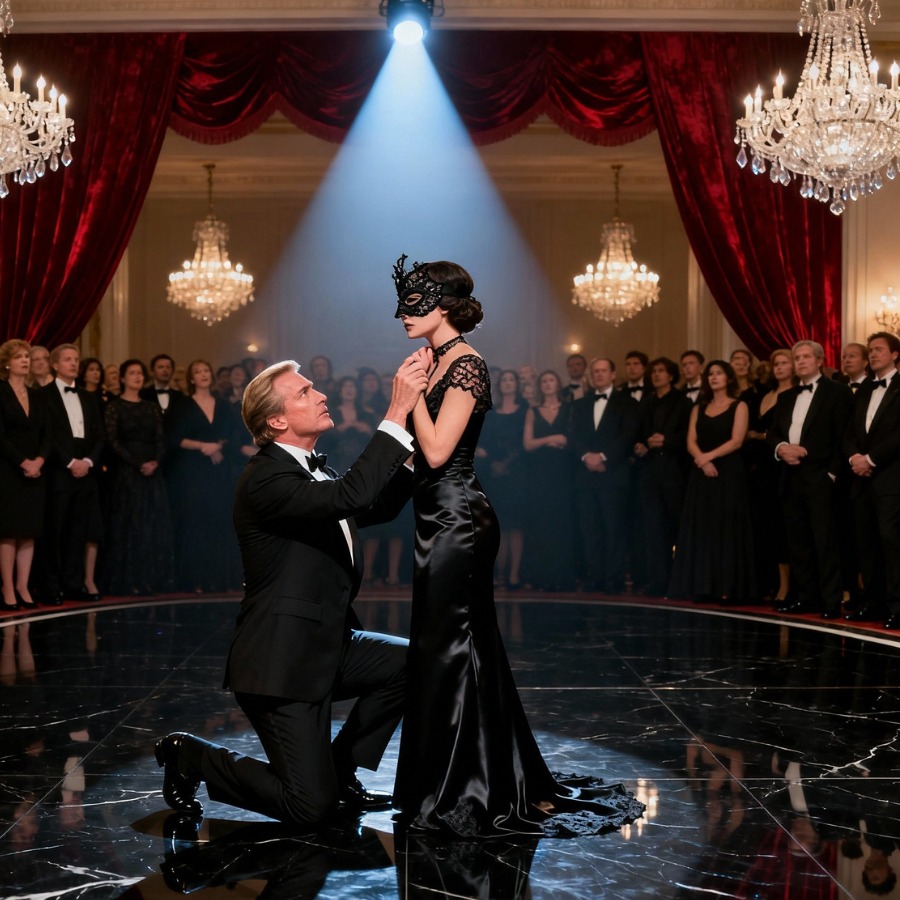
Part 1 – Terms and Conditions
Maria didn’t sleep.
She spent the night at the hospital instead, curled up in the visitor’s chair beside Diego’s bed. Machines hummed softly around them, blinking in gentle patterns like distant constellations. Every time she let her eyes close, she saw the auction room again—faces turned up toward a stage, the flash of a paddle, the number that had frozen the world:
$500,000.
Half a million dollars for five events and one international trip with a stranger.
Not quite a stranger.
Adrian Blackwell.
She studied her brother instead of her thoughts.
Diego’s cheeks looked too pale against the white pillow, his curls flattened by the bed. Even in sleep, he frowned a little, as if his body was tired of fighting.
“You’re gonna be okay,” she whispered. “I promise.”
She could say that now.
Sometime around dawn, a nurse came in with a folder.
“Miss Santos?” she said quietly. “We got word from billing. Your brother’s surgery has been fully funded. Mercy General’s already coordinated with the donor’s representatives.”
Maria’s throat tightened.
“Already?” she managed. “Who…?”
The nurse shrugged, professional but kindly.
“Some private foundation,” she said. “Happens more than you think. Someone with resources sees a case and decides to help. Whatever the reason, your brother’s scheduled for pre-op tests today. Surgery within the week.”
After she left, Maria pulled her phone out with trembling hands.
A new email sat in her inbox: TRANSFER CONFIRMATION.
Her balance showed numbers she had never dared imagine in her account.
Less a foundation, more a man who had looked at her on a stage and changed everything with one bid.
Blackwell.
She stared at the name on the business card he’d given her, the silver letters catching the hospital’s fluorescent light.
“Who are you?” she whispered.
The car arrived at exactly 9:00 a.m.
Black. Immaculate. Silent on the curb like a predator at rest.
“Miss Santos?” the driver asked, opening the back door.
Maria smoothed her thrift-store blouse, suddenly self-conscious about every wrinkle, every evidence that she didn’t belong in the kind of world where cars like this were… normal.
“Yes,” she said.
The leather interior smelled faintly of something expensive and clean—no air fresheners, no fast-food grease. The city slid by the tinted windows as if it were on a screen: brick walk-ups, corner bodegas, then polished glass towers as they crossed into downtown again.
The car turned into the private entrance of a skyscraper she’d only ever seen from a distance: BLACKWELL TECHNOLOGIES in discreet, brushed metal letters near the revolving doors.
Inside, marble and glass and quiet money.
The receptionist knew her name.
“Miss Santos, Mr. Blackwell is expecting you,” she said. “Top floor.”
The elevator didn’t jerk or jolt. It just hummed upward, her stomach dropping slightly as the numbers climbed.
By the time the doors slid open, Maria’s pulse was racing.
Adrian’s office looked like something out of a movie—floor-to-ceiling windows with a view of the entire city, shelves of books and awards, a desk that probably cost more than her parents’ first house.
He stood by the glass, hands in his pockets, back to her.
When he turned, the space seemed to rearrange itself around him.
Close up, he looked even more intense. His dark hair was perfectly in place, his suit a deep charcoal that somehow made his eyes—cool, gray, unreadable—stand out even more.
“Miss Santos,” he said. “Thank you for coming.”
His voice was exactly as she remembered it from the auction: controlled, steady, almost quiet. The kind of voice used to being listened to.
“Thank you for… everything you did,” she said, her own voice small in comparison. “I—there aren’t words.”
“There’s no need,” he said, waving faintly toward the chairs in front of his desk. “Sit, please.”
She perched on the edge of the nearest chair, feeling like a stray cat in a luxury pet boutique.
Adrian sat opposite her, not behind the desk. Not above. Across.
He set a folder on the small table between them.
“As I explained last night,” he said, “the arrangement is straightforward. Five major events where you accompany me as my partner. One international trip. You will be presented publicly as my… romantic other.”
He said the last part like it was an unpleasant but necessary medical term.
“Outside of that performance,” he continued, “our interactions remain strictly professional. You’ll have your own room when travel is required. You’ll have a dedicated contact on my staff. You can refuse any physical contact you’re not comfortable with. Hand-holding. Kissing for cameras. Even that is negotiable. I understand how this… sounds.”
“Like I’m a paid actress,” she said.
“Essentially,” he agreed. “With a very good salary.”
She swallowed.
“And if I say no?” she asked. “If I decide I can’t do it?”
His gaze didn’t waver.
“Your brother’s surgery is already paid,” he said. “That doesn’t change. The transfer to your account is yours. Consider that… non-refundable.”
It was such an odd way to phrase a gift that she almost smiled.
“So you paid half a million dollars for one night,” she said slowly, “and you’re telling me I could walk out right now and never see you again.”
“Yes,” he said simply.
“Then why…” She spread her hands helplessly. “Why make this arrangement at all? Why not just donate anonymously and forget about me?”
Something flickered in his eyes. Annoyance. Amusement. She couldn’t tell.
“Because the auction was the tip of an iceberg,” he said. “I rarely do anything ‘just once.’ My board has been… insistent that I appear more human in public settings. Investors respond better to executives with families, relationships, photographs in magazines that look… normal.”
He said “normal” like an absurdity.
“And you decided to buy one,” she said.
“Rent,” he corrected. “Not buy. Borrow. Contract. You are not property.”
The way he said it made it clear he found the idea distasteful.
“Do you always solve problems with money?” Maria asked before she could rein her tongue in.
He didn’t flinch.
“Almost always,” he said. “It’s efficient.”
“That sounds lonely,” she murmured.
A muscle jumped in his jaw.
“It’s safe,” he countered.
She tipped her head.
“No,” she said softly. “It’s just empty. Safety isn’t the same as living.”
For a brief second, something unguarded crossed his face—an old pain, quickly shuttered.
“You’re very direct,” he said.
“I don’t have time not to be,” she replied. “My brother’s on an operating schedule.”
He exhaled once, like a man adjusting to altitude.
“The terms are in here,” he said, tapping the folder. “You may take them home, read them over, have an attorney look if you wish. I won’t rush you.”
She thought of Diego’s thin wrists, the way his hand felt in hers when he was afraid. Of the nurse’s words: pre-op tests, scheduled.
“You already changed everything,” she said. “I’m not going to insult both of us by pretending I’m hesitant now. I… agree. To the terms.”
His brows lifted barely a fraction.
“Without reading the contract?” he asked.
“I’ll read it,” she said. “But I know what really matters here.”
“And what is that?” he asked.
“You already showed me who you are when you didn’t have to,” she said quietly. “The rest I can navigate.”
He studied her for a long moment, as if she were a puzzle someone had handed him unexpectedly.
“You’re an art gallery assistant,” he said. “Why?”
She blinked at the sudden turn.
“Why?” she repeated.
“You have a degree from a state university,” he went on. “Top of your class. Plenty of student debt, judging by your financials. You could have chased higher-paying roles. Marketing. Corporate design. Something… more lucrative.”
“Because money isn’t the only thing that matters,” she said.
“Spoken like someone who’s never really had it,” he replied.
“Spoken like someone who’s had to choose between paying the electric bill and buying paint,” she shot back. “Art matters. Beauty matters. Even when life is ugly.”
He leaned back, a ghost of a smile touching his mouth.
“Patricia was right,” he murmured.
“Patricia?” Maria asked.
“The coworker who told you about the auction,” he said. “She wrote a note on your file. ‘Be careful with this one. She believes in things.’”
Maria felt heat rise in her cheeks.
“I was told there would be no intimacy required,” she said briskly, needing to steer away from the sudden vulnerability.
“There won’t be,” he said. “Not unless you decide otherwise. And even then, I reserve the right to decline.”
She blinked.
“Decline?” she echoed, caught off guard.
“As I said,” he replied, voice cool again, “genuine relationships are… complicated in my world. I learned a long time ago that mixing business and intimacy is like mixing oil and fire.”
“Have you ever tried water instead?” she asked.
He frowned faintly.
“What?”
“Nothing,” she said quickly. “Bad metaphor.”
Silence stretched between them, not entirely uncomfortable.
He broke it first.
“Our first event is Saturday night,” he said. “A charity gala for a medical research foundation. Dress code is black-tie. I’ve arranged for a stylist to meet you at your apartment tomorrow. You will not have to pay for anything. Consider it… wardrobe budget.”
“I don’t own anything black-tie,” she said. “I barely own anything tie.”
“That’s why I have people,” he said, as if it were obvious. “You’ll have final say. I’m not interested in turning you into something you’re not. The whole point is that no one believes I hired you.”
“You did,” she reminded him.
“Yes,” he said. “But they don’t need to know that.”
Her stomach fluttered.
“What exactly are you expecting me to… do?” she asked. “At these events.”
“Be there,” he said. “Stand at my side. Smile when appropriate. Answer small talk. Pretend we like each other.”
Her lips twitched.
“That last part might be the hardest,” she said.
One corner of his mouth lifted before he could stop it.
“We’ll ease into it,” he said. “Do you have any questions?”
She had a thousand.
“What happens when it’s over?” she asked. “After the five events, the trip. Do we just… walk away?”
“If that’s what you want,” he said.
“And what do you want?” she asked.
The question hung in the air.
He looked out the window for a moment, at the city he’d built an empire over.
“Clarity,” he said finally. “Control. A way to manage expectations without… lies.”
“You’re literally paying a stranger to pretend to be your girlfriend,” she said gently. “How is that not a lie?”
“It’s a contract,” he replied. “Everyone involved knows the truth even if the cameras don’t. That’s the difference.”
She considered him.
“No,” she said softly. “The difference is whether you ever let anyone see you without the script.”
His jaw tightened.
“This is not therapy, Miss Santos,” he said.
“Good,” she said with a faint smile. “Because you couldn’t pay me enough for that.”
For a heartbeat, he looked like he might laugh. He didn’t. But his eyes softened, just a fraction.
“Saturday,” he said. “My driver will pick you up at seven. Wear whatever the stylist gives you or whatever makes you feel like you can walk through fire and come out intact.”
“Trust me,” she said, standing. “I’ve already done that once this week.”
As she reached for the folder, his voice stopped her.
“Maria.”
It was the first time he’d used her first name.
She looked back.
“Yes?”
“I meant what I said at the auction,” he said. “You didn’t belong there.”
Her throat tightened.
“Maybe not,” she said. “But I belong here even less.”
He held her gaze.
“Give it time,” he said. “You might surprise yourself.”
As she left his office, clutching the contract and his card, Maria realized the strangest part wasn’t that a billionaire had bought one night with her and turned it into a business arrangement.
It was that, for the first time, someone with everything had looked at her desperation and seen something besides a problem to be solved.
He’d seen her.
She wasn’t sure that made any sense.
But as she stepped back into the elevator and glanced at her reflection in the mirrored walls, she saw something new in her own eyes.
Not just fear.
Not just exhaustion.
Something that looked uneasily like… possibility.
Part 2 – First Night on Display
The stylist arrived the next afternoon with two rolling racks and a small army of garment bags.
Maria’s entire apartment could have fit inside one garment bag.
“I’m Lila,” the woman said, sweeping in with effortless confidence, tape measure around her neck like a necklace. “I work with Mr. Blackwell’s public-facing disasters.”
Maria blinked.
“Disasters?” she echoed.
“Men in expensive suits who think that’s the same thing as having a wardrobe,” Lila said. “You, on the other hand, are raw material. Which is my favorite thing.”
She scanned Maria head to toe, not unkindly—more like a sculptor evaluating marble.
“Turn,” she ordered.
Maria turned.
“Good posture. Great shoulders. Your eyes are ridiculous. Hair we can work with.” Lila clicked her tongue. “Okay. Tonight is black-tie. They’ll expect you to show up in something that says ‘I belong here’ but doesn’t scream ‘I’ve been rehearsing my whole life for this.’ Which, judging by your closet—”
She opened it and paused at the sight of a lot of thrift, a lot of black, and one dress suitable for weddings if you didn’t look too closely.
“—you definitely haven’t,” she finished cheerfully.
Maria folded her arms.
“I don’t want to pretend to be someone I’m not,” she said. “I just… don’t want to embarrass him.”
“Relax.” Lila smiled. “We’re not here to turn you into a different person. We’re here to show the most expensive room in the city what I can see from your hallway: you’re the kind of woman they’ll assume he had to fight to earn, not buy.”
That sounded even worse, somehow.
But as the measuring tape circled her waist and Lila held dresses up against her, Maria felt something she hadn’t in a very long time.
Seen. But not judged.
They settled on a dress Maria would never have chosen for herself: deep midnight blue instead of black, the fabric soft and fluid, draping rather than clinging. The neckline was modest but elegant; the back dipped lower than she was strictly comfortable with.
Lila handed her a pair of silver heels.
“I can’t walk in those,” Maria protested.
“Yes, you can,” Lila said. “You walked into a stranger’s office and signed a half-million-dollar arrangement. You can handle four inches.”
Maria laughed despite herself.
Later, after Lila had coaxed her hair into soft waves and given her a makeup look that somehow made her face look like itself, just… more rested, Maria stood in front of her bathroom mirror and stared.
She recognized the woman in the reflection. But she felt like she was seeing a version of herself from some other timeline—one where student loans hadn’t strangled her career, where art school had led to gallery shows instead of gallery coffee runs.
Her phone buzzed with a message from the hospital.
Pre-op completed. Surgery scheduled: Tuesday, 9 a.m.
She pressed her hand against the vanity to steady herself.
“You’re going to be okay,” she whispered to Diego’s name on the screen. “I’m going to make sure.”
The car arrived at seven sharp.
“Miss Santos,” the driver said, opening the door.
She slid into the back seat, dress rustling softly, clutch in her lap, heart hammering in her chest.
Tonight, she reminded herself, was not about her.
It was about being… an accessory.
A very expensive one.
The Blackwell Technologies Charity Gala looked like a movie set.
Crystal chandeliers. Linen-draped tables. A string quartet in the corner. People in gowns that probably cost more than her rental car once had, tuxedos cut so precisely they might have been grown in a lab.
Maria stepped through the doors on the arm of a man who made all of it look normal.
Adrian had met her in the hotel lobby, every bit as composed as he’d been in his office. In a black tuxedo, he was almost too polished, like a photograph come to life.
For a moment, as he took her in—dress, hair, makeup—something sharp flashed in his eyes. Surprise. Approval.
“You clean up well,” he said.
“It’s mostly Lila,” she replied. “I’m just… the hanger.”
His mouth almost curved.
“Lila’s highlight reels don’t walk on their own,” he said. Then, more softly: “You look… so much like yourself that I almost didn’t recognize you.”
She wasn’t sure how to take that.
He offered his arm.
“Ready?” he asked.
“No,” she said honestly. “But let’s go anyway.”
Now, inside, the ballroom seemed to inhale around them.
Heads turned.
A ripple went through the high-society crowd the way it always did when Adrian Blackwell entered a room—except this time, the waves hit differently.
They weren’t just looking at him.
They were looking at her.
Maria could feel the curiosity like heat on her skin.
Who is she?
Where did he find her?
How serious is this?
She forced her fingers to loosen on his arm.
“This is where you smile,” he murmured under his breath, lips barely moving. “Think about your brother. Think about what tonight will bring him.”
She lifted her chin and smiled.
Not the wide, fake grin she’d practiced once in a restroom mirror.
A small one. Real. Fragile.
It seemed to disarm people more than any megawatt beam would have.
Introductions blurred together.
“Maria, this is James Harper, chair of the board. James, this is Maria Santos.”
“Pleasure.”
“Dr. Liu, our lead researcher. She’s the reason this event exists. Maria, Dr. Liu is single-handedly making sure your brother’s surgery has the equipment it requires.”
Dr. Liu’s handshake was firm, her smile genuine.
“I’ve read Diego’s chart,” she said. “He’s in good hands.”
The room tilted for a second.
“You… know about him?” Maria asked.
“Adrian made sure I did,” Dr. Liu replied. “As soon as his foundation committed funds, we prioritized your brother’s case. It’s not typical, but he can be… persuasive.”
She shot Adrian a wry look.
Persuasive. Of course.
Maria’s heart softened a little more.
At one point, a woman glided over like a shark in silk.
“Adrian,” she purred. “You never told us you’d upgraded.”
She was beautiful in a sharp, polished way—perfect hair, perfect teeth, a dress that shimmered like oil. Her eyes flicked over Maria with clinical assessment.
“And this must be…?” she asked, voice full of sugar and poison.
“Maria Santos,” Adrian said evenly. “Maria, this is Elise Davenport. She runs half of Wall Street’s gossip mill.”
Elise smiled.
“Oh, darling,” she said to Maria, “I hope he warned you. Men like Adrian don’t usually do long term. They get… bored with toys quickly.”
Maria felt heat rise in her face.
Before she could fumble a response, Adrian’s posture shifted ever so slightly.
His arm tightened around hers.
“Elise,” he said, “you’re confusing me with your last husband.”
A few nearby guests choked on their champagne.
Elise’s smile froze for half a heartbeat, then smoothed back into place.
“Well,” she said. “You’ve certainly found your sense of humor since the last board meeting.”
She touched his sleeve—barely—and drifted away.
“Friend of yours?” Maria asked under her breath.
“Relative term,” he said. “Old… acquaintance.”
“She hates me,” Maria said.
“She hates anyone she can’t predict,” he replied. “Take it as a compliment.”
Hours passed.
She smiled, nodded, listened as Adrian navigated donors and investors with calm precision. He introduced her as “my partner” so easily that sometimes she forgot this was all a script.
Sometimes, the way his hand settled lightly at her back felt too natural.
They danced once—obligatory, he claimed, for photographs.
His hand at her waist, palm warm through the thin fabric of her dress. Her hand in his, small and unsure.
“Relax,” he murmured. “If you get through one waltz without stepping on me, tabloids will decide you’re royalty.”
“And if I do?” she asked.
“They’ll decide you’re human,” he said. “Which would be worse—for them, not for me.”
She made it through the waltz without mangling his feet. Mostly because he guided her, subtle pressure at her waist, quiet corrections.
“Where did you learn to dance like this?” she asked.
“My parents were old-fashioned,” he said. “Fundraiser balls. Charity dinners. I had a tutor for everything—languages, fencing, dancing, stock analysis by age fifteen.”
She shook her head.
“I learned to dance in my kitchen,” she said. “Radio turned up too loud. Bare feet. Lots of laughing.”
He looked down at her, something soft and aching in his gaze.
“That sounds… better,” he said.
The band segued into something faster, and they slipped off the floor, giving way to couples more eager to show off.
Later, as the auction portion of the evening—donations, pledges—wound down, Adrian stepped up to the podium for a brief speech.
Maria stood to the side, heart pounding for reasons that had nothing to do with public speaking.
He spoke without notes.
About research. About outcomes. About what money could do when it wasn’t just a number on a balance sheet.
He didn’t mention Diego by name.
He didn’t have to.
Maria felt the room shift when he said, “For some families, this isn’t about statistics. It’s about one life. One person they love. The kind of desperation that would make you walk into a room like this and sell yourself if you had to.”
His eyes flicked toward her for a fraction of a second.
No one else noticed.
She felt it like a bolt.
When it was over, donors clapped, pledges were made, champagne flowed.
By midnight, the crowd had thinned.
“Ready?” Adrian asked quietly, appearing at her elbow like a shadow.
“To go home?” she asked, voice hopeful and exhausted.
“To escape,” he corrected.
He guided her toward a side exit, avoiding the main crush.
Even so, when they stepped outside, the sharp pops of camera shutters made her flinch.
Paparazzi.
“Mr. Blackwell! Over here!”
“Adrian, who’s the mystery woman?”
“Ms. Santos, are you together?”
The questions crashed over them like hail.
Maria stiffened.
Adrian leaned in, his breath warm at her ear.
“You’re safe,” he said. “Just keep walking.”
He moved closer, arm snug around her waist in a way that felt less staged now, more protective. The flashbulbs strobed white across his face.
“Adrian, give us a smile!”
“Can we get a kiss?”
Someone shouted it. The rest took it up like a dare.
“Kiss! Kiss!”
Maria’s stomach lurched.
She’d agreed to hand-holding. To being on his arm. Maybe even to a cheek-kiss if absolutely necessary.
She had not prepared for a chant.
She felt him pause.
Every instinct in her wanted to run.
“You don’t have to,” he said quietly. She almost didn’t hear him over the noise. “We can walk right past them.”
She took a breath.
If she flinched now, if she ducked away from him, every photo would be freeze-framed, analyzed. The narrative would spin out of control by morning.
She thought of Diego going into surgery in four days.
She forced herself to tilt her head up.
“Just… don’t make it a soap opera,” she whispered.
The corner of his mouth twitched.
“Never,” he murmured.
He bent his head.
His lips brushed hers.
Not a claim. Not a devouring.
Soft.
Controlled.
If anything, it felt like restraint—even in the middle of flashing lights and shouted questions. He kissed her the way he did everything else in public: with precision, with an awareness of angles, of optics.
Still, heat shot through her like she’d been plugged into one of his servers.
Her fingers curled in the lapel of his tux without permission.
Then he pulled back, just enough that she could see his eyes.
They were not as cold as steel tonight.
They looked… surprised.
At her.
At himself.
“Enough,” he said toward the cameras, his voice ice again. “That’s all you get.”
Reporters laughed.
They walked the rest of the way to the waiting car in a flurry of questions that didn’t really expect answers.
Inside, the door thudded shut, mercifully muffling the noise.
Maria exhaled shakily.
Her lips tingled.
“Are you okay?” Adrian asked.
She surprised herself by laughing.
“I don’t know yet,” she said. “Ask me when my heart slows down.”
He watched her in the dim light.
“You did well,” he said. “Better than most people who’ve been doing this their whole lives.”
“Being kissed by billionaires?” she asked. “Yeah, I’m a natural.”
“Handling pressure,” he said. “That’s what I meant.”
She rubbed her fingers together against the satin of her clutch.
The car pulled away, city lights streaking past.
She realized she was still trembling.
“Maria,” he said slowly. “If tonight crossed any lines you weren’t ready for, you need to tell me. We can adjust. The point of this arrangement is not to… traumatize you.”
“It’s not that,” she said quickly. “It’s just…”
She broke off.
He waited.
“I’ve never done that before,” she blurted.
He blinked.
“Been at a gala?” he asked.
“Been kissed,” she said.
“Properly.”
The word hung in the car like a fragile thing.
His brows knit.
“You’ve never…?” he began, then stopped, recalibrating. “At all?”
She stared at her hands.
“Unless you count sloppy, beer-breath pecks at high-school parties that I usually dodged,” she said. “I’ve never… actually been kissed. Not like that.”
He sat back, as if someone had just presented him with an equation that didn’t compute.
“You’re twenty-four,” he said. “You’ve never had a boyfriend?”
“Not a real one,” she said. “Art school boys liked the idea of me more than the reality of ‘sorry, I have to double-shift to pay rent.’”
His gaze searched her face.
“You’re telling me,” he said slowly, “you walked into an auction like that without… any frame of reference. You were prepared to—”
She cut him off, cheeks blazing.
“I wasn’t prepared for anything,” she said. “I was prepared to do whatever it took to save my brother. There’s a difference.”
Silence.
He let out a breath, almost a laugh, but there was no humor in it.
“You’re a virgin,” he said quietly, not as an accusation. As a conclusion he couldn’t quite believe he was drawing. “In every sense of the word.”
She flinched.
“That supposed to be an insult?” she asked.
“No,” he said quickly. “No. It’s just… unexpected. In my world, innocence is usually a performance. A pose. Not a… fact.”
She stared out the window.
“It’s not like I planned it,” she said. “It’s just… life kept getting in the way. And then when things got hard—money, Diego—I told myself that if I was going to give that part of myself away, it would at least be to someone who saw me as more than a… novelty. Or a conquest. Or a charity case.”
Her throat felt tight.
“And then I walked onto that stage,” she said bitterly, “and sold my time to a stranger with more money than God. So much for that principle.”
“Stop,” he said sharply.
She looked at him.
“You’re not for sale,” he said. “Your time, your presence, your performance at public events, yes. That’s the contract. But your body, your choices, your… firsts? Those are not assets in a portfolio.”
He ran a hand through his hair, something he hadn’t done yet in front of her. It made him look less invincible.
“For the record,” he said, “I had no idea.”
“I know,” she said. “The auction wasn’t exactly advertising ‘slightly used, emotionally stable, never-been-kissed.’”
He exhaled sharply, the ghost of a smile appearing despite the heaviness.
“You’re making jokes,” he said. “That’s either a good sign or a very bad one.”
“Occupational hazard of not having a therapist,” she replied.
They fell quiet again.
“Maria,” he said finally, voice lower. “I want to be very clear about something. I am not going to be your first anything unless you very explicitly, very soberly, and very freely ask me to be. No contracts. No debts. No auctions. Unless it’s something you want for yourself, independent of all this… arrangement, it doesn’t happen. Understood?”
She studied him.
For the first time since she’d met him, he looked… uncertain. As if her answer mattered more than a deal closing.
“Yes,” she said softly. “Understood.”
“And for the record,” he added, some of his usual composure returning, “the kiss outside? That was for the cameras. If I’d known—”
“I still would have said yes,” she cut in before he could apologize. “That’s the worst part. I knew what I was agreeing to. I just didn’t know the… side effects.”
“Side effects?” he echoed.
She touched her lips.
“I think my heart’s still in that driveway,” she said.
He looked away, jaw working.
“You’re … dangerous,” he muttered.
She blinked.
“Me?” she scoffed. “You’re the billionaire who buys people at auctions.”
“I bought time,” he said. “And somehow ended up with a person whose principles are stronger than my lawyers.”
The car slowed.
Her building came into view.
He glanced at the window, then back at her.
“You did well tonight,” he said again. “I know it didn’t feel like one night with a price tag. But it will pay for a lifetime for your brother.”
She swallowed.
“Thank you,” she said. “For… everything.”
He nodded once.
“Rest,” he said. “Be with Diego. We’ll take a break until after his surgery. The public narrative can give way to the real story for a few days.”
“The real story?” she asked.
His gaze held hers.
“Sister sits beside brother’s bed until he wakes up,” he said. “That’s the only headline that matters right now.”
Her eyes burned.
“Goodnight, Adrian,” she said.
“Goodnight, Maria.”
She stepped out of the car, the night air cool on her cheeks.
Upstairs, in her small apartment, she slipped off the midnight blue dress and hung it carefully, as if it were on loan from another universe.
In the bathroom mirror, she saw the smear of lipstick at the corner of her mouth where his kiss had landed, caught in the paparazzi’s flash.
She wiped it away.
The feeling stayed.
She lay in bed later, phone pressed to her chest, contract forgotten on the nightstand.
Adrian Blackwell had paid half a million dollars for one night everyone assumed was about sin.
Instead, he’d discovered a secret she hadn’t meant to share.
And somehow, instead of turning it into leverage, he’d turned it into a promise.
Her first night in his world had ended without anyone crossing a line they couldn’t uncross.
But the lines inside her?
Those were already blurring.
Part 3 – The Night No One Paid For
Hospitals always smelled like lemon cleaner and fear.
Maria sat with her hands wrapped around a cup of coffee that had gone cold an hour ago, watching the second hand on the waiting-room clock drag itself around the circle.
Every time the doors swung open, she tensed.
“Miss Santos?”
She was on her feet before the surgeon finished saying her name.
Dr. Kline still wore his cap, mask pulled down around his neck. He looked tired—but not grim.
“The surgery went well,” he said.
Maria’s knees almost gave out.
“Really?” she whispered. “He’s okay?”
“He’s stable,” Dr. Kline said. “We repaired the defect and reinforced the surrounding tissue. It was complicated, but there were no unexpected complications, which is exactly what we like to say. He’ll be in the ICU for a bit, then step-down. The next forty-eight hours are important, but barring anything unusual… your brother has an excellent prognosis.”
She covered her mouth with both hands.
“Thank you,” she choked out. “Thank you, thank you—”
He held up a hand, half-smile softening his features.
“Thank Blackwell,” he said. “All I did was my job.”
When he left, she sagged into a chair.
She didn’t realize she was crying until someone pressed a tissue into her hand.
“Breath, honey,” an older woman across the aisle said kindly. “You’re turning purple.”
Maria laughed, hiccupping.
Her phone buzzed.
A text from an unknown number:
A: How is he?
She stared at the initials for a second, then typed with trembling fingers.
M: Surgery went well. The doctor said “excellent prognosis.”
M: I don’t… I can’t… Thank you doesn’t feel like enough.
Dots appeared.
A: Good.
A: That’s the only acceptable outcome.
She smiled through tears.
M: You sound like you bullied the surgery itself.
A: If I could have, I would have.
A: Stay with him. We’ll talk when you’re ready.
She looked through the ICU window later, watching Diego sleep under a tangle of tubes and wires, monitors painting his heartbeats in peaks and valleys.
For the first time in months, she let herself believe in a future.
Not just one where he survived.
One where he lived.
They didn’t see each other for five days.
Adrian sent flowers to the hospital. Not giant, showy arrangements. Small, neat ones—bright bursts of color in clear glass jars that fit on Diego’s bedside table.
He texted once a day.
No pressure. No directives. Just brief check-ins that sometimes bordered on awkward.
A: How is he today?
M: Complaining about hospital food. I think that’s a sign of recovery.
A: Agreed. Ungrateful brat.
M: Excuse you, that “ungrateful brat” is my favorite person.
A: Mine too, temporarily.
Somewhere between day three and four, she realized she was looking forward to the tiny gray bubbles that meant he was typing.
On day six, as she was coaxing Diego through his first painful lap around the ward, her phone buzzed again.
A: Maria, when you have a moment, we should discuss the next event. And the trip. No rush. Just logistics.
M: He just walked. Like, walked-walked. I cried in the hallway.
A: Did he fall?
M: No. It hurt a lot. But he did it.
A: Then you’re allowed to cry. Logistics can wait another day.
She showed Diego the flowers’ note cards, keeping the names vague.
“He sounds fancy,” Diego said, eyeing the careful handwriting.
“He is fancy,” Maria said. “And extremely annoying.”
“Like a rich Batman?” Diego asked.
“If Batman had a corporate board instead of a bat signal, maybe,” she said.
Diego leaned back against his pillow.
“You like him,” he said simply.
She opened her mouth—and then closed it.
“I don’t know him,” she said.
“That’s not an answer,” Diego pointed out.
She changed the subject.
He rolled his eyes but let her.
The international trip was to London.
“Board wants me visible at the European launch,” Adrian had said when she’d finally gone back to his office. “Media. Investors. A charity dinner. It’s a good opportunity to show the ‘human’ side they keep insisting I have.”
He’d made finger quotes around “human.”
“Do you?” she’d asked lightly.
“Borderline,” he’d replied.
He explained the itinerary with his usual precision.
Flight on the company jet. Two nights at a hotel where the lobby looked like the inside of a jewelry box. A tech conference keynote, a black-tie dinner, a morning meeting with regulators.
Her role was the same.
Smiling accessory.
Unexpectedly, she found she didn’t dread it.
London’s gray drizzle and double-decker buses felt like an entirely different planet from the hospital’s antiseptic corridors and the cramped corners of her life in the city.
On the flight over, she’d expected him to bury himself in work.
He did, for a while. Laptop open, eyes scanning slides and reports.
Then, somewhere over the Atlantic, he closed it.
“Tell me about your art,” he said.
She blinked.
“My art?” she repeated.
“You didn’t end up in a gallery because you like dusting frames,” he said. “You paint. Or sculpt. Or do something involving obscenely priced materials and sleep deprivation.”
“Someone’s bitter about art school admissions,” she teased.
“I never applied,” he said. “My father told me at age ten that if I wanted to ‘play with colors,’ I could buy a museum when I was older.”
She winced.
“I did,” he added. “For the record. It was… unsatisfying.”
She hesitated.
“I paint,” she said. “Mostly oil. People. Light. Messy stuff. I had a few pieces in student shows. Nothing professional.”
“Do you still paint?” he asked.
“When I can afford canvases,” she said. “When I’m not working or at the hospital.”
“You don’t consider what you’re doing for your brother part of your art?” he asked.
She frowned.
“What does that even mean?” she said.
He shrugged.
“Art is choosing to create something beautiful or meaningful when the world gives you every excuse not to,” he said. “You walked onto that stage, into my office, into this arrangement, with your principles intact. That’s… rare.”
She looked at him.
“You say things like that,” she said slowly, “and then pretend you’re just a spreadsheet with legs.”
“Don’t insult my legs,” he said dryly. “They’ve carried me through many dull conferences.”
She laughed.
The jet hummed on.
For a moment, at thirty thousand feet, they were just two people in a metal tube, suspended between the lives they’d had and whatever came next.
London paparazzi were somehow both more polite and more ruthless than their stateside counterparts.
They shouted questions in charming accents.
“Mr. Blackwell! Over here!”
“Miss Santos, is this a whirlwind romance?”
“We heard you’re engaged!”
Adrian’s hand settled on her back, steady.
“We’re here for the technology,” he said to one reporter. “Not a soap opera.”
He didn’t deny the “romance,” Maria noticed.
Inside the conference center, the flash and noise faded into the controlled chaos of tech launches—screens, lights, people in badges and lanyards.
She watched him work.
On the stage, he was a different sort of person—still composed, still precise, but energized. Talking about innovation, security, ethics. He wasn’t just parroting talking points; he believed in what he was building.
When someone pushed back during a Q&A about automation replacing jobs, he didn’t deflect.
“We have a responsibility to build systems that augment human potential, not erase it,” he said. “That’s not just good press. It’s good business. People don’t trust companies that treat them as… expendable inputs.”
His eyes flicked to her briefly at that word.
Expendable.
Later, at the dinner, seated at a table where the flatware weighed more than her old phone, she overheard snippets.
“Blackwell’s changed since his father died.”
“He’s less… ruthless.”
“Still brilliant. Still guarded.”
“Guarded” was an understatement.
Back at the hotel, after the second night’s charity function—a blur of handshakes and speeches—Maria kicked off her heels in the hallway with a groan.
“I take back every nice thing I’ve ever thought about shoes,” she muttered.
Adrian’s mouth twitched.
“You did well,” he said. “Again.”
“You keep saying that,” she replied. “At this point I’m starting to suspect you mean it.”
“I do,” he said. “You make it… easier.”
“To pretend?” she asked.
“To be seen and not feel hunted,” he said quietly.
She leaned against the wall, the carpet plush under her bare feet.
“You know,” she said, “for someone who bought a fake relationship, you talk a lot like you want a real one.”
He sighed.
“Wanting and allowing are two different things,” he said.
“What happened?” she asked softly. “Before all this. Who hurt you enough to make you think control was better than connection?”
The hallway felt very quiet.
He stared at the room numbers as if they might give him an excuse not to answer.
“My father,” he said after a long moment. “Primarily.”
She stood up straighter.
“He was…” Adrian searched for the word. “Demanding. Brilliant. Not… kind. Every mistake was a disappointment. Every success was the bare minimum. He married three times. Treated each wife like a… beautiful asset until she stopped being useful to his image.”
Maria listened, heart tight.
“And your mother?” she asked.
“Wife number one,” he said. “She left when I was twelve. Took what she could, but that wasn’t much, legally. I learned early that people leave. Or change the terms. Or decide you’re not worth it. Unless there’s a contract.”
“That’s not love,” Maria said.
“It’s what I saw,” he answered.
“Have you ever… loved someone?” she asked.
The question came out more vulnerable than she intended.
He stared at the carpet.
“I thought I did,” he said. “Once.”
“Thought?” she echoed.
“She liked the idea of me,” he said. “The access, the power, the spotlight. She liked playing the part. When she realized my father’s estate wouldn’t give her what she felt she deserved… she left. And sold her… story to anyone who would pay attention.”
He said “story” with visible distaste.
“Every private argument became a headline,” he said. “Every doubt I’d confided turned into ammunition. After that, I decided the only safe secrets are the ones you don’t give away.”
Maria stepped closer, barefoot on the thick carpet.
“I’m sorry,” she said.
He shrugged, as if brushing it off.
“I learned,” he said.
“And what did you learn?” she pressed. “That no one is trustworthy?”
“That unpredictability is dangerous,” he said. “That feelings cloud judgment. That if you treat relationships like contracts, you minimize… risk.”
She shook her head.
“You also minimize joy,” she said. “And surprise. And the possibility that someone might choose you when they don’t have to.”
He looked at her, something raw in his expression.
“You’re very certain for someone with no experience,” he said.
“With men like you?” she shot back. “Maybe. With love? Enough fictional couples have kept me up at night that I’ve absorbed a few things.”
He actually laughed.
It surprised both of them.
“Careful,” she said. “If you smile too much, your board will think you’ve been replaced by a pod person.”
It faded slowly, but it had been real.
“Goodnight, Maria,” he said eventually.
“Goodnight, Adrian,” she replied.
She slipped into her room, heart pounding for reasons that had nothing to do with jet lag.
She pressed her back to the door and slid down, satin of the dress pooling around her.
Somewhere down the hall, separated by walls and fear, a man who had paid to keep his heart safe was slowly, reluctantly, letting her see it.
She had no idea what to do with that.
But she knew this much:
He wasn’t a villain in a suit.
He was a boy who’d grown up learning all the wrong lessons about love, now trying to unlearn them with ledgers and contracts.
And she was a girl who’d sold one night of her life to save her brother and ended up renting out her heart, installment by installment.
The shift between them wasn’t a single moment.
It was a series of small ones.
Maria visiting Diego and finding a new game console in his room with a note: “Recovery is boring. – A.”
Adrian calling her after a board meeting, voice flat, and actually answering when she asked, “Are you okay?” instead of deflecting.
Her noticing how he always stepped between her and a camera flash, absorbing the worst of it.
Him noticing how she always changed shoes between events, keeping flats in her bag and slipping them on when no one was looking.
One evening, over takeout in his office between meetings, she said, “You know, you’re allowed to enjoy things.”
He looked up from his salad.
“I enjoy plenty of things,” he said. “Profit margins. Efficient workflows. Stable markets.”
“That’s not enjoying,” she said. “That’s… monitoring. Managing. When was the last time you did something just because it made you feel good?”
He opened his mouth. Paused.
“Define ‘feel good,’” he said.
She groaned.
“Adrian,” she said. “A hobby. A movie that made you laugh. A walk that wasn’t between this building and a car.”
He frowned as if she’d asked when he’d last visited Mars.
“That’s what I thought,” she said.
“What do you suggest?” he asked, half-wary.
She thought.
“Come to the gallery,” she said.
“The one that pays you barely enough to survive?” he asked.
“Yes,” she said. “There’s a new installation next week. Local artists. Weird and wonderful. You might hate it. That’s fine. Hating something is still a reaction.”
He sighed.
“I have quarterly earnings calls,” he began.
“Of course you do,” she said. “You also have a calendar and a PA who can carve out ninety minutes. You paid half a million dollars to bring me into your world. The least you can do is visit mine for an hour.”
He was quiet a moment.
Then nodded.
“Fine,” he said. “One hour. No press. And if someone asks, I’m there to review their security systems.”
She smiled.
“Deal,” she said.
He caught the word.
“Careful,” he said. “That almost sounded like a contract.”
“Contracts can be good things,” she replied. “When both people actually want to be in them.”
He looked at her.
She looked back.
Neither of them said what they were both thinking.
What do we want this to be?
The night of the gallery visit, he showed up in clothes that did not look like a uniform: dark jeans, a sweater, a coat that somehow still screamed money but in a quieter tone.
“You’re undercover,” she teased.
“I’m attempting to blend,” he replied. “As you suggested.”
The gallery was small, the lighting less flattering than the galas’. The crowd was a mix of students, artists, older patrons with genuine interest and very little influence.
He watched her in her element.
She moved between pieces with ease, talking about brushwork, about context, about how one installation made her feel “like my thoughts were leaking onto the floor, and not in a bad way.”
He listened.
Really listened.
At one point, they stood in front of a large canvas—swirls of color colliding, thin lines of charcoal cutting through.
“What do you see?” he asked.
She tilted her head.
“Chaos,” she said. “But not random. Like… someone took a map and crumpled it and painted the feeling of being lost and hoping you’ll find your way again.”
He studied it.
“I see,” he said slowly, “a business plan.”
She snorted.
“Of course you do,” she said.
“Let me finish,” he said. “Initial concept. Early ambitions. External shocks. Revisions. The underlying structure holds, even if the path changes.”
“Only you could turn a painting into a pitch deck,” she said.
He glanced at her.
“Only you could make me look at it and see anything else,” he replied.
Her heart did that bolt thing again.
She slipped her hand into his without thinking.
He stiffened—then relaxed, fingers threading through hers.
No cameras. No contract.
Just a man and a woman in front of a painting, surrounded by strangers who had no idea who he was.
In that moment, she realized something.
He was more at ease here, in anonymity, with color and mess, than at any table where everyone knew his net worth.
“You’re a person,” she said suddenly.
He looked down at her, eyebrows raised.
“Good to know,” he said dryly.
“I mean it,” she insisted. “Not just a CEO. Not just the man who saved my brother. You could stand in this room and no one would ask you for anything. You could just… exist.”
“That sounds dangerous,” he murmured.
“Or like living,” she countered.
He squeezed her hand.
Weeks passed.
Events blurred together—fundraisers, conferences, charity dinners. The international trip turned into two as his schedule expanded and he insisted, “We might as well get full value from this arrangement, don’t you think?”
She saw him in different cities, in different lights.
She saw how he treated waitstaff—with quiet respect.
How he dealt with crisis—with calm, contained fury that never spilled onto the wrong people.
How he always checked his phone at the end of the night, looking for updates from Diego’s doctors, even after the surgery, even after the danger had passed.
“You don’t have to keep doing that,” she told him once. “He’s okay now.”
“We agree on very little,” he said. “We can agree on the fact that there are some things you never stop watching.”
She thought of her art.
He thought of his company.
They thought of each other.
The last event on their contract was another gala.
Same hotel as the first auction. Different ballroom.
This time, she walked in on his arm without feeling like a prop.
She’d chosen the dress herself—a simple one in soft gold that made her skin look warm and her eyes bright. Lila had approved with a thumbs-up gif.
“You look…” Adrian began, then stopped.
“Like myself?” she suggested.
“Yes,” he said. “Dangerously so.”
They moved through the room together, no longer a billionaire and his rentable companion.
They were a unit.
People saw it.
They didn’t flirt for cameras.
They didn’t stage kisses on demand.
They shared glances. Small jokes. Brief touches that meant more than any scripted display.
At one point, during a lull, he led her onto a quiet terrace.
“I have something to discuss with you,” he said.
Her stomach dipped.
“This is when you tell me the contract’s up,” she said. “And we go our separate ways. Professionally. Obviously.”
He studied her face.
“Is that what you want?” he asked.
She looked out at the city.
Lights sparkled. Cars moved like veins of light.
“What do you want?” she asked softly.
He took a breath.
“For the first time in a very long time,” he said, “I am considering wanting something without a clause. Or an exit strategy. Or a backup plan.”
She turned slowly.
He stepped closer.
“The contract officially ends tonight,” he said. “You owe me nothing after this. No more events. No more pretending. No more obligations to my schedule, my image, my board’s expectations.”
He paused.
“But I find myself… very unwilling to give up your presence,” he said. “In my life. In my inbox. In my head.”
Her heart pounded.
“Are you asking me to… extend?” she asked.
“In a way,” he said. “But not with the same terms.”
He met her eyes.
“No money,” he said. “No pretense. No pre-negotiated kisses for cameras. No obligations beyond what you choose every day. We can continue as… friends. Or something more. Completely on your terms.”
She swallowed.
“And if I say no?” she asked.
“Then I go back to my spreadsheets and my board and my carefully managed solitude,” he said quietly. “And you go back to your art and your brother and your life. And I will be grateful for what we had. For what you showed me. And I will not contact you unless you reach out.”
It was the most vulnerable thing she’d ever heard from him.
“What do you want?” he asked again, softer this time. “Not for Diego. Not for the version of you that walked onto that stage. For you. Maria.”
She thought of her brother laughing at the new game console.
Of Lila’s exasperated affection.
Of Henry’s texts from the gallery saying, “When are we seeing your work on these walls?”
Of Adrian, in jeans, in a gallery, looking at a painting and seeing his own chaos reflected.
She stepped closer.
“I want…” she said, voice shaking just a little, “to see what happens when we stop pretending.”
His breath hitched.
“Define ‘stop pretending,’” he said, echoing their earlier banter.
She smiled.
“I want to be your friend,” she said. “And maybe, slowly, clumsily, terrifyingly, your partner in the real sense. Not because you bid the highest, not because a contract says so. Because I choose you. And you choose me. And we both try very hard not to run when it gets hard.”
He exhaled, a sound half laugh, half something broken-healed.
“Maria,” he said. “For the first time in my life, that sounds… better than safe.”
She lifted a hand, resting it against his cheek.
“You’re still allowed to be scared,” she said. “I’m scared.”
His hand covered hers.
“But we move forward anyway,” he murmured. “Together.”
“If,” she added, “you understand that this doesn’t mean I’m going to let you micromanage our relationship with spreadsheets.”
He actually smiled.
“Deal,” he said.
No lawyers. No notary.
Just two people on a terrace, choosing.
He bent his head.
This time, the kiss wasn’t for cameras.
It was slower. Warmer. Less precise.
There was no pretense.
Just the taste of champagne and something sweeter. The feeling of his hand at the nape of her neck. The sense that, in spite of everything, this was the moment she’d held back for—through bad high school parties, through fear, through desperation.
Her first real kiss.
Given, not bought.
She smiled against his mouth.
“What?” he whispered.
“You just became my first,” she said softly. “On purpose.”
He rested his forehead against hers.
“And you,” he said, “just became my first real risk.”
They stood there a while, breathing each other in, the noise of the gala muted behind glass.
When they finally went back inside, nothing looked different.
The chandeliers still gleamed. People still laughed. The city still pulsed outside.
But between them, everything had shifted.
One night at an auction had started as a transaction.
Now, standing under lights that made diamonds and sweat equally bright, Maria realized something.
Adrian hadn’t paid half a million dollars to own a piece of her life.
He’d invested in the possibility of his own.
And whether they crashed and burned or built something lasting, it would be theirs this time.
Not the board’s.
Not the paparazzi’s.
Not the auctioneer’s.
The story everyone thought had been about a virgin sold for one night was really about something else:
A billionaire who had bought safety for so long he’d forgotten what it felt like to live—
And a woman whose desperation had forced her into his orbit—
Choosing, together, to risk everything the world couldn’t put a price on.