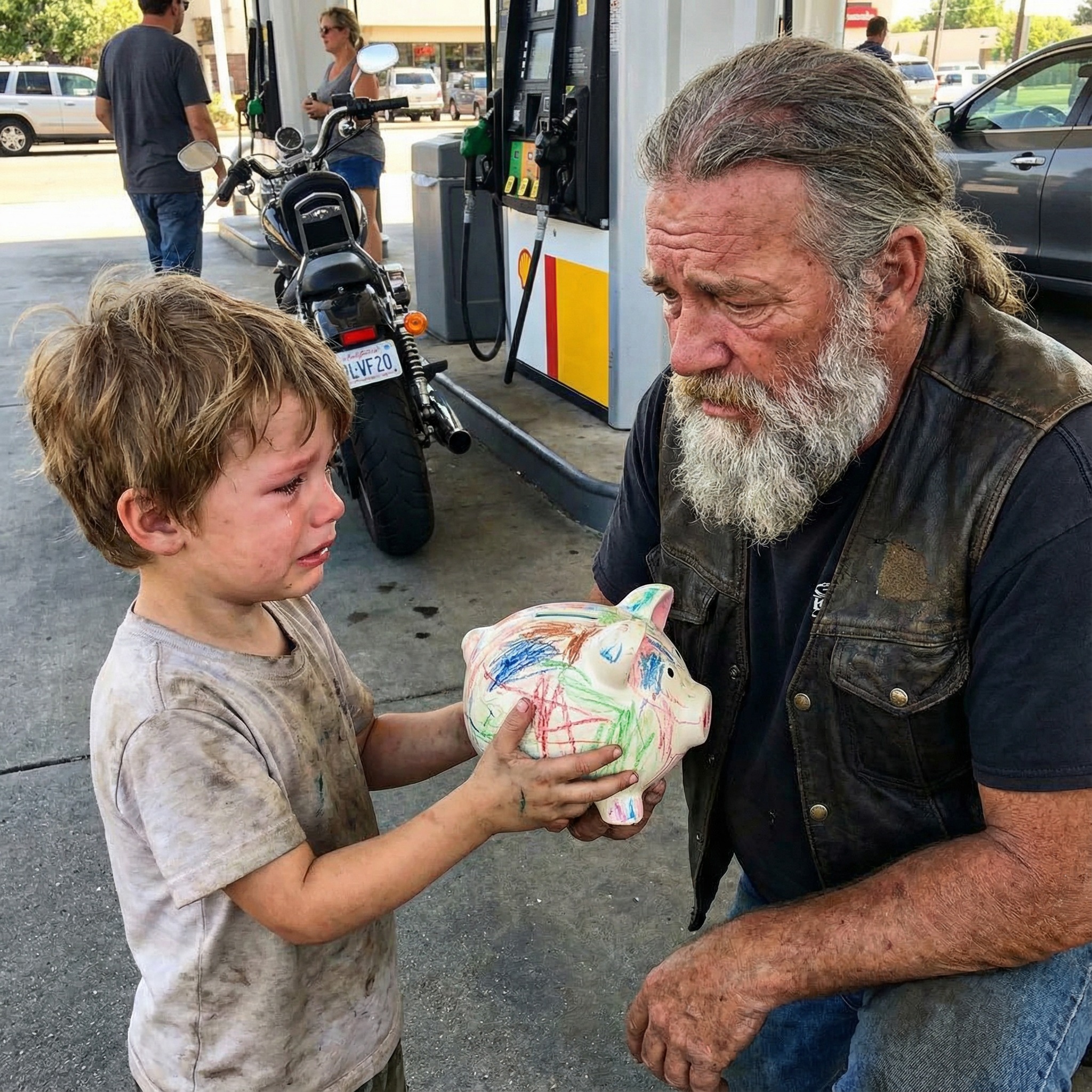
It happened on an ordinary afternoon at a gas station, the kind of place people pass through without remembering, until a moment turns it into something permanent. I had just finished fueling my motorcycle when I felt a light tug on my leather vest. I turned and saw a little boy, no older than five, holding a chipped ceramic piggy bank covered in crayon scribbles. His hands were shaking. His face was streaked with tears. Then he said the six words that stopped time: “Please make my daddy stop hurting mommy.”
I am sixty-three years old. I’ve spent four decades riding motorcycles, served my country, and retired after a long career in law enforcement. I’ve seen violence up close, seen families shattered, seen fear hollow people out from the inside. I thought I was past the point where anything could truly shock me. I was wrong. Looking at that child, offering up his entire world in loose change, something inside me cracked wide open.
He pushed the piggy bank into my hands and told me it held forty-seven dollars. He had counted it himself. It was everything he owned, and he was willing to give it away if it meant the yelling would stop, if it meant his mother wouldn’t cry anymore. Up close, I saw the bruise on his cheek. Fresh. Finger-shaped. The kind of mark that never comes from “falling down.”
He pointed across the parking lot to a rusted pickup truck. Inside, a man was shouting, face twisted with rage, while a woman cowered beside him, her hands raised defensively. The boy whispered that it happened every day. Sometimes the man hit him too when he tried to help. The night before, his mother had bled and wouldn’t wake up for a long time. Those words hit harder than any punch I’d ever taken.
I told the boy his name was brave, that he didn’t have to pay me, that helping was not something bought or sold. He didn’t believe me at first. He said his father wasn’t afraid of police. Officers had come before, but his mother always lied to protect the man hurting her. That is how abuse survives: through fear, silence, and isolation.
I asked the boy to stand by my motorcycle and not move. He nodded, clutching the piggy bank to his chest like armor. As I walked toward that truck, every lesson I had ever learned about de-escalation, presence, and control came rushing back. I no longer wore a badge, but I still understood violent men. I knocked on the window and asked the driver to step out.
He tried bluster first, then intimidation. When that failed, he reached for anger. I stopped him with truth. I told him what his son had offered me. I told him what I could see on his wife’s arms and his child’s face. I gave him a choice: walk away now or deal with the consequences that would follow if the truth finally came into the open.
That was when my brothers arrived. Other bikers, men who know loyalty and accountability better than most people realize. They didn’t posture. They didn’t threaten. They simply stood there, calm and unmoving, a wall between a violent man and the family he terrorized. The balance of power shifted instantly.
The woman stepped out of the truck then. Her voice was barely a whisper. She tried to minimize, to protect him even now. That is what fear does. I told her gently that she was not fine, and that her son knew it. The man laughed, said he would always find her, that no one could stop him. He believed that because no one ever had.
Until now.
Faced with witnesses, with certainty, and with the knowledge that the truth was no longer contained, he folded. He left in a fury, spitting insults that carried no power anymore. The moment he drove away, the woman collapsed to the ground, sobbing, the tension draining out of her body all at once.
We didn’t celebrate. This was not a victory. It was the first step in survival. We returned the piggy bank to the boy and told him he was brave beyond his years. We contacted a domestic violence shelter, coordinated safe transport, and stayed close. This is the most dangerous moment for a victim: when they leave.
For days, we took turns standing watch outside the shelter. The man came back, drunk and screaming. Police came too. Protective orders were filed. Arrests followed. Each time he tried to intimidate, the system responded, supported by people who refused to look away.
Over the next months, the woman rebuilt her life piece by piece. Housing assistance. Legal advocacy. Trauma counseling. Employment support. The child healed slowly, learning what it meant to feel safe. Our motorcycle club raised funds quietly, without publicity or credit, because real help does not need applause. What mattered was stability, dignity, and time.
Six months later, we were invited to the boy’s birthday. He wore a tiny leather vest with a simple patch that said “Guardian.” His smile was different now. Lighter. His mother looked like someone who could breathe again. She told us that the moment her son reached out to a stranger, everything changed. He broke the silence that had kept them trapped.
Years have passed since that afternoon. The restraining order remains. The man is gone. The boy is growing, strong and kind, saving his coins again, not to buy protection, but for his future. He says he wants to help other kids someday. I believe him.
People see bikers and make assumptions. They see leather, scars, and steel and think danger. Sometimes they’re right. We are dangerous to abusers, to men who believe fear gives them power. To everyone else, we are exactly what that child needed that day: someone willing to stand between violence and the vulnerable.
That little boy taught me something I will carry for the rest of my life. Courage doesn’t look like size or strength. Sometimes it looks like a child with a piggy bank, asking for help when no one else will. And sometimes, all it takes to change everything is one person who refuses to walk away