For the past few years, life has forced Simon Cowell to slow down in ways he never expected. Known globally for his sharp tongue, relentless work ethic, and commanding presence on television, Cowell has built a career that thrives on momentum. But behind the scenes, a series of painful and frightening incidents pushed him into a period of reflection that reshaped not only his health, but his priorities as a father.
Over a span of just two years, Cowell suffered two serious bicycle accidents, both involving electric bikes. The first occurred in 2020 in Malibu, an incident that sent shockwaves through the entertainment industry when it was revealed he had broken his back. The second followed in early 2022 while he was riding through London, once again landing him in the hospital. For a man whose life had long revolved around packed schedules, global productions, and constant travel, the physical consequences were impossible to ignore.
When Cowell later appeared on the Today Show alongside his fellow America’s Got Talent judges, the tone was noticeably different from his usual bravado. Howie Mandel, Terry Crews, and Heidi Klum acknowledged the accidents with candor, and Cowell himself spoke openly about how deeply the experiences had affected him. At 64, he admitted that he hadn’t been in the best physical condition even before the crashes, and that the recovery period forced him to confront that reality head-on.
He described the aftermath as a genuine wake-up call, a moment of reckoning he hadn’t seen coming. Rehabilitation was not just about healing bones and regaining mobility. It was about reassessing how he lived, how hard he pushed himself, and what truly mattered when everything else was stripped away. For someone known for his near-obsessive dedication to work, that realization didn’t come easily.
Despite the injuries, Cowell surprised many by refusing to give up cycling altogether. In promotional interviews for later seasons of America’s Got Talent, he spoke with genuine fascination about e-bike technology and insisted that he still loved riding. To him, the accidents weren’t a reason to retreat from life, but a reminder to engage with it more consciously. Still, the medical toll was undeniable. After the second accident, doctors diagnosed him with a concussion and a broken arm. The earlier crash had been far worse, leaving his back stabilized with metal rods and screws after surgery.
Yet the physical pain was only part of the story.
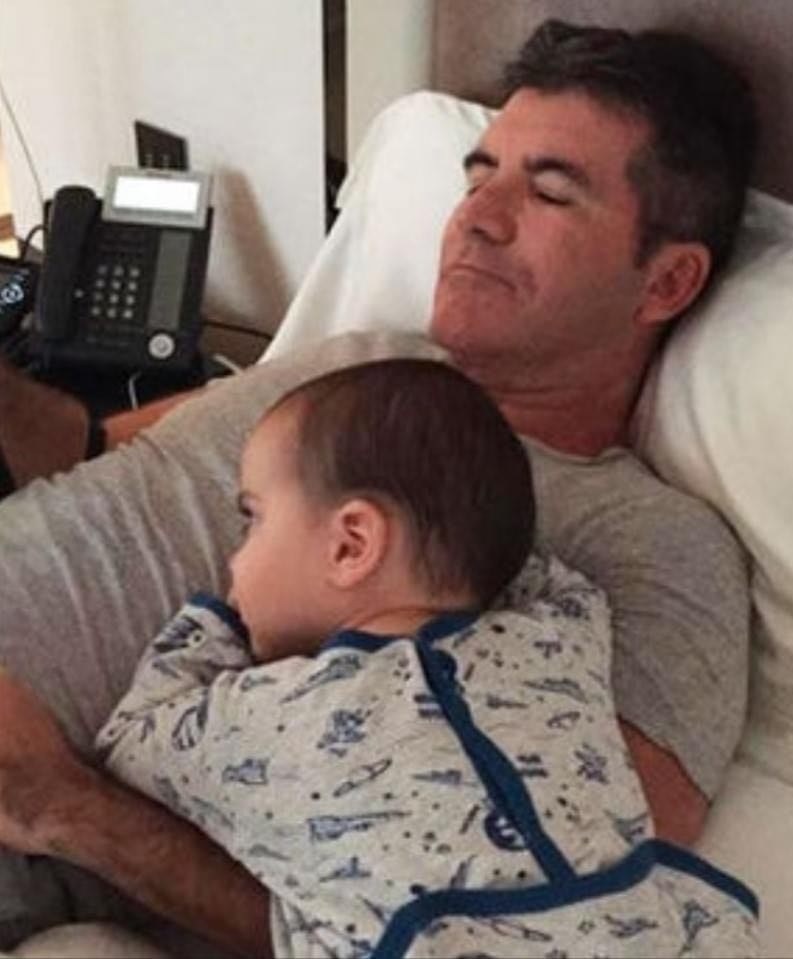
What truly unsettled Cowell was how the injuries affected his relationship with his son, Eric. Born on February 14, 2014, Eric is the center of Cowell’s private world, a role he has openly embraced in recent years. During his recovery, Cowell admitted that he fell into a dark emotional place. For the first time in his life, he seriously considered therapy, something he had never previously imagined himself doing.
In interviews, he spoke about the frustration and sadness of feeling unable to fully engage with his son. Simple activities—walking together, playing football, spending carefree time outdoors—suddenly felt uncertain. For a father who wanted to be present and active, that loss weighed heavily. He confessed that there were moments when he struggled to even explain his feelings to Eric, a vulnerability that marked a sharp contrast to his public persona.
Lauren Silverman, Cowell’s fiancée and Eric’s mother, played a crucial role during this period. Her support and encouragement helped anchor him while he navigated both physical recovery and emotional strain. Together, they focused on creating stability for their son, even as Cowell adjusted to a slower pace of life.
Eric, for his part, responded with a mix of innocence and humor that seemed to lift his father’s spirits. After seeing Cowell at home with braces, scars, and limited movement, the young boy gave him an unexpected nickname. Comparing his father’s surgically reinforced back to something out of a superhero movie, Eric declared that Simon looked like Iron Man. Cowell later recalled the moment with pride and laughter, saying it helped him reframe the situation in a lighter, more hopeful way.
Publicly, Cowell has since learned to joke about his injuries, even as he acknowledges their seriousness. He has downplayed some of the more alarming moments, including a later on-set accident during America’s Got Talent in 2021, choosing humor over drama. When Terry Crews once asked whether he could imagine himself performing the acrobatic stunts demonstrated by a Shaolin Kung Fu act on the show, Cowell responded with self-deprecating honesty. After hurting his back, he said, simply walking around the garden with Eric felt like a major achievement.
Still, the drive that made Cowell one of the most influential figures in global entertainment hasn’t disappeared. He continues to judge, produce, and shape television at the highest level, balancing resilience with newfound caution. The difference now lies in perspective. Success is no longer measured solely by ratings, contracts, or viral moments, but by time spent with family and the ability to show up for his son in meaningful ways.
Cowell’s journey over these past few years reflects a broader narrative familiar to many high-achieving individuals. Serious health scares have a way of stripping away illusions of control, forcing even the most powerful people to confront vulnerability. In Cowell’s case, those moments led to introspection rather than retreat. He adjusted his lifestyle, acknowledged his limits, and allowed fatherhood to take precedence over relentless ambition.
Today, Simon Cowell stands as a figure shaped not just by fame and fortune, but by recovery, humility, and parental devotion. His accidents were painful, frightening, and disruptive, but they also clarified what he values most. He still rides his bike. He still works. He still jokes. But beneath the surface, there is a man who understands that survival and success mean little without the people you love beside you.
In that sense, the hardest decisions Cowell has made in recent years weren’t about television formats or talent contracts. They were about choosing health, presence, and fatherhood over the unchecked pace that once defined his life. And for all his public bravado, that quiet shift may be his most meaningful transformation yet.