My daughter spent the last hours of her life listening to three leather-clad strangers sing until their voices broke. They never stopped—not when their throats burned, not when their fingers bled, not when exhaustion made their hands shake. They sang because the moment the music paused, my little girl slipped back into terror.
My name is Sarah Martinez, and my daughter Lily came into this world already fighting for her life. She was born with a brain tumor the size of a golf ball. The doctors said she’d survive six months at best. Somehow, she made it to eighteen.
But those final days… nothing prepares you for that kind of pain. Her tumor had grown so large it pressed into the nerves that controlled her pain response. The morphine stopped helping. She screamed for hours—tiny body arched, fists clenched, eyes wild with agony. Nurses fled the room in tears. Parents down the hall begged to be moved. I held her through three straight days without sleep, begging God to help her, begging Him to take her if He wasn’t going to ease her suffering.
Then, when I was at my breaking point, they appeared.
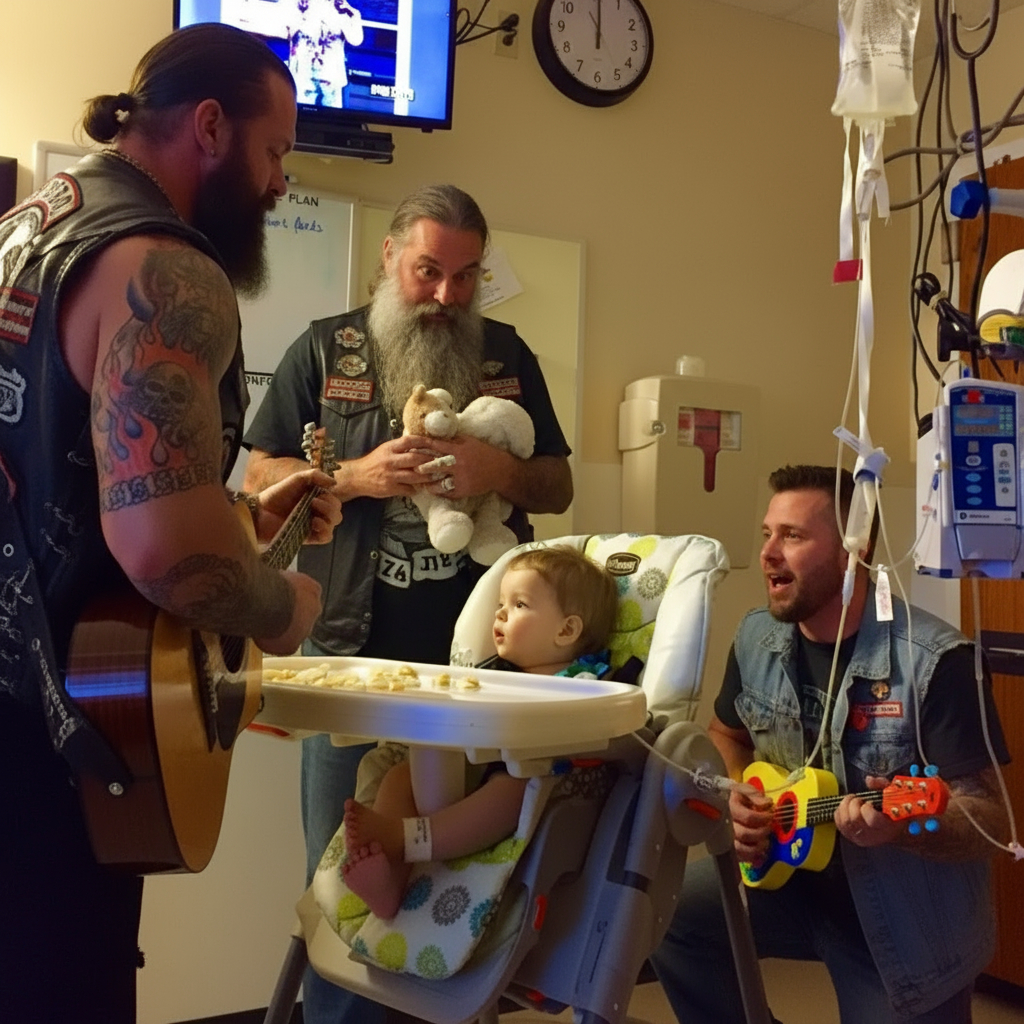
Three bikers. Leather vests. Tattoos. Instruments in hand.
The biggest one stepped forward. “Ma’am, we’re from the Riders of Grace motorcycle club. The hospital chaplain called. Said a little one here might need some music.”
I didn’t have it in me to object. “She won’t stop screaming,” I whispered. “Nothing helps.”
Tommy—the one holding a ukulele—asked gently, “What’s her favorite song?”
“She doesn’t have one,” I said. “She’s spent most of her life in a hospital bed.”
He sat beside her crib and started playing “Twinkle Twinkle Little Star.” His voice was rough as gravel… but soft. So soft.
And Lily stopped screaming.
For the first time in four days, she went quiet. Her eyes fluttered open. She looked at him. She reached a shaky hand toward the ukulele and sighed.
Marcus joined in with a guitar. Robert grabbed a teddy bear from his pocket and made it dance beside her pillow. And my dying baby—my suffering, exhausted, medicated baby—smiled.
That smile gutted me.
“Please,” I whispered, “don’t stop.”
But moments later, a security guard stormed in.
“You need to leave,” he barked. “You’re not authorized, and you’re disturbing other patients.”
Marcus tried calmly, “We have permission from the child life department—”
“I don’t care,” the guard snapped. “You look like gang members.”
I snapped out of my shock. “They’re helping my daughter!”
He turned to me, annoyed but unmoved. “Rules are rules.”
That’s when the biggest biker—Thomas—stepped forward.
“Brother,” he said quietly, “my daughter died in a hospital like this. She was five. Leukemia. She begged for music, but they wouldn’t let us play it. Said it might disturb others. So my little girl died scared. In silence. I swore I would never let another child die that way if I could help it.”
He pulled out a photo of a bald little girl grinning in a hospital bed. “This is Sofia. She never got her last song. This baby deserves hers.”
The guard looked at Lily… then at me… then at the bikers.
“You have thirty minutes,” he said. “Then I have to report this.”
Those thirty minutes turned into twelve hours.
When Tommy’s fingers cracked and bled from the ukulele strings, Marcus took over. When Marcus’s voice rasped into nothing, Robert sang until he nearly collapsed. They rotated like soldiers in a war zone, but the music never stopped.
They played every children’s song in existence. When they ran out, they made up new ones—ballads about Lily the Brave, Lily the Fighter, Lily the Baby Who Out-sang Pain.
Parents brought them coffee. Nurses brought bandages and throat lozenges. The head of pediatric oncology, Dr. Chen, told administration, “These men stay. The music is the only thing reducing this child’s suffering.”
And she was right. The music soothed her when nothing else could.
Late that night, Lily’s breathing changed. Slowed. Grew uneven. Dr. Chen pulled me aside. “It won’t be long,” she said gently. “Maybe hours.”
I returned to her bedside and found Tommy crying as he sang—actual tears dripping onto his ukulele.
“I had a granddaughter,” he murmured, still strumming. “Bella. SIDS. Ten months old. I never got to say goodbye. When the chaplain called, I… I had to come.”
Marcus whispered, “We all lost children. That’s why we built this club. To honor them. To help families like ours.”
I didn’t know that. They didn’t tell me because, as Robert said, “This isn’t about us. It’s about her.”
At 3 a.m., Lily’s little eyes fluttered open. She found me. Reached out.
I gathered her into my arms.
The bikers began singing “Amazing Grace.” All three of them, their voices strained but steady.
I pressed my cheek to her forehead. “It’s okay, baby. Mommy loves you. You’re safe. You can rest.”
She let out one small breath.
Then stopped.
The music fell silent.
Tommy stood, legs shaking. He kissed her forehead. “Ride free, little angel.”
Marcus and Robert followed, each whispering goodbye to the baby they had sung across the bridge.
They stayed for her funeral. All forty-seven members of their club came. They carried her tiny casket. They sang “You Are My Sunshine” at her graveside, and not a single voice cracked until the last note faded.
Then they built something extraordinary.
The Lily Martinez Music Fund.
In two years, they’ve raised over $200,000 so no dying child has to spend their last hours in silence and fear. Hundreds of families have been helped. Hundreds of babies have been comforted.
And the bikers still check on me. Still bring flowers on Lily’s birthday. Still show up on Mother’s Day.
Last month Tommy called. “Sarah… there’s another baby. Brain cancer. Parents alone. She won’t stop crying.”
I didn’t hesitate. “Go. Sing. I’ll meet you there.”
I watched them do for another child what they did for mine. I watched them break their hearts all over again so someone else’s baby wouldn’t have to die in pain.
That baby—Hope—lived six more days. And for every hour of those six days, the Riders of Grace sang.
She died smiling.
People think bikers are dangerous, rough, unapproachable.
But I know the truth.
They are angels in leather. Angels on motorcycles. Angels who use music as medicine. Angels who refuse to let a child face death alone.
My daughter didn’t die screaming. She died in my arms, wrapped in music, surrounded by men who carried their own grief like armor and still chose to love her.
Most people get angels when they die.
My Lily got bikers who sang her all the way home.