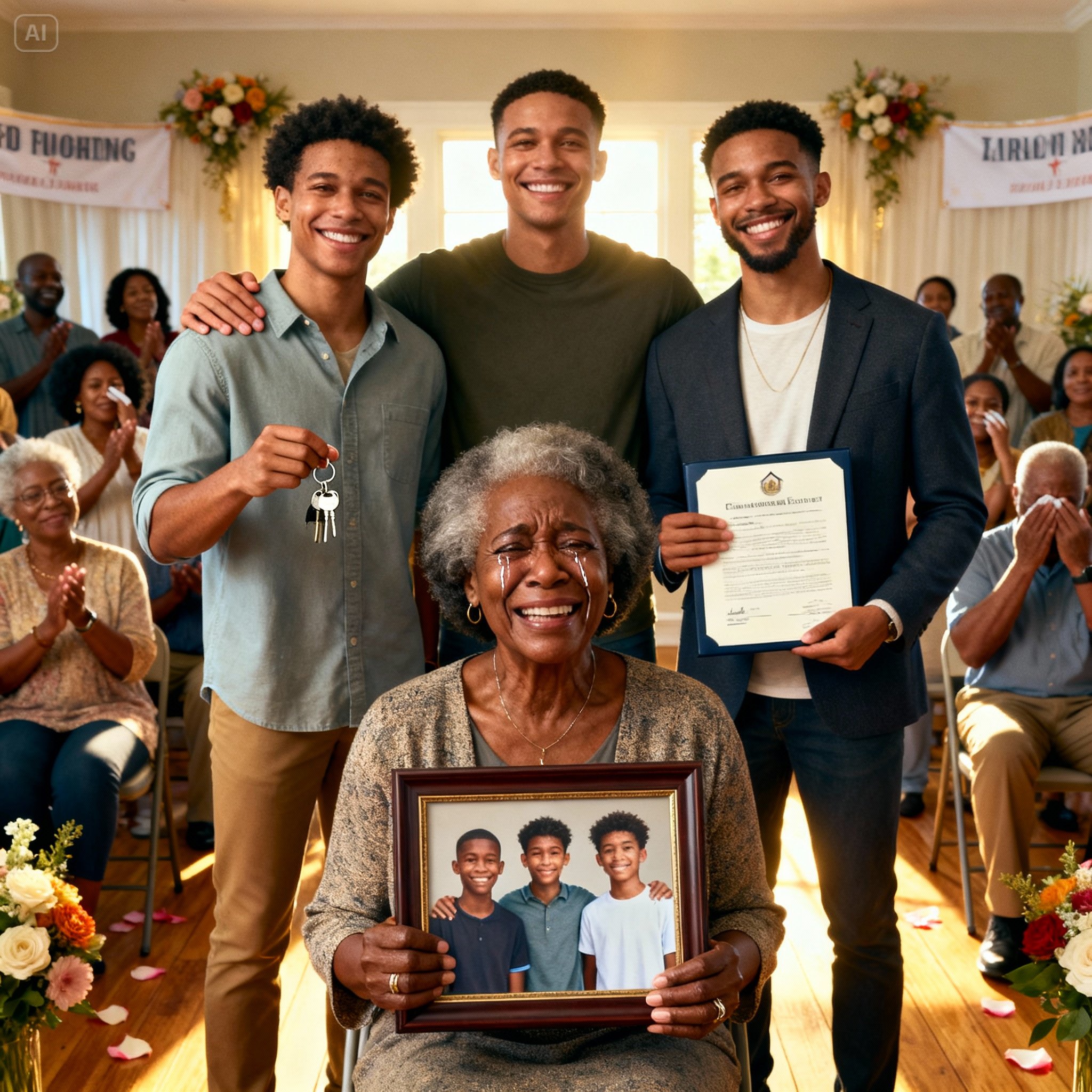
The day three black cars pulled up outside my mother’s crumbling brick house, the neighbors thought someone had died.
I watched from the pavement as curtains twitched up and down the street in Birmingham. Kids paused their football game. Mrs. Patel from number 12 stopped mid–sweep of her front step, broom hanging in the air.
Inside, my mother, Mary Johnson, sat on her little porch with a chipped mug of tea, her gray cardigan too thin for the breeze. Her hands, knotted with arthritis, shook around the cup when she saw us step out of the cars in our suits.
“Boys,” she whispered, pushing herself upright with her cane. “My boys…”
We walked toward her—three men now, tall, well-dressed, the kind of men strangers assume grew up with everything. James, the eldest, already had tears in his eyes. Daniel’s jaw was tight, like he was holding something back. I, Michael, held the envelope that would change everything.
“Mama,” James said, pulling her into his arms.
Daniel kissed her cheek. “We missed you.”
She laughed and cried at the same time, that shaky sound we hadn’t heard in years. “What’s all this? I ain’t dead yet. Why’re you dressed like bankers?”
I felt my throat tighten.
“Because today,” I said, taking her hand, “is about you.”
She frowned, confused. “About me?”
The neighbors leaned closer to their windows.
They had called her foolish once. A poor black nanny with barely enough money to feed herself, showing up one day with three unwanted boys. They’d shaken their heads, whispered that she was ruining her life.
They had no idea what was about to happen on that quiet street.
But to understand that moment—to understand why my mother’s knees would nearly buckle when she saw what we’d done—we have to go back twenty-five years.
Back to the day a tired woman in a thin coat pushed open the door to an orphanage and did something nobody expected.
My name is Michael Johnson, and I was four years old the first time I saw my mother.
I don’t remember every detail of that day. Some of it is my memory, blurred at the edges. Some of it is what she told us later, in that soft Alabama drawl she never quite lost.
But I remember the rain.
It was one of those Birmingham afternoons when the sky hangs low and gray, and the drizzle feels like it’s seeping through your bones. My mother—back then just “Mary Johnson” to the world—was walking home from one of her cleaning jobs, shoulders hunched under a cheap umbrella.
She was in her early thirties, a black woman far from where she’d been born, with strong arms and tired eyes. She spent her days scrubbing other people’s floors, cooking other people’s dinners, minding other people’s children.
And then going home alone.
She came from Alabama, from a town whose name sounded like dust. Her mama had sent her across the ocean at nineteen to work.
“Mary,” her mother had told her on the porch, hands on her cheeks, “you got the gift of love in you. Don’t waste it. Use it where God tells you.”
Mama always said those words followed her like a shadow.
That day in Birmingham, she was just thinking about drying her socks over the heater and stretching a tin of soup into dinner when she heard it:
Children laughing.
She slowed down, water dripping off her umbrella.
The sound wasn’t quite right. It was laughter, but thin, like it came from kids who weren’t used to laughing for long.
She looked up.
A small brick building sat tucked between a corner shop and a row of houses. A tired sign over the door read: “Saint Mary’s Orphanage.”
She stood there on the pavement, staring at that door.
She could have walked on.
She didn’t.
She pushed it open.
The smell hit her first. Disinfectant and porridge. Clean, but not warm.
Children were scattered around a playroom with faded wallpaper. Some played with blocks, some chased each other in circles, their voices echoing against the walls.
But in the corner, there were three.
Three boys who weren’t playing at all.
The first was small and pale, with messy blonde hair. He held a broken toy truck in both hands like it was the last thing keeping him anchored to earth.
James.
The second boy sat with his chin pressed to his chest, staring at the floor. Seven years old, but his eyes looked older. He had that kind of stillness kids shouldn’t know yet.
Daniel.
Then there was the third.
Me.
A four-year-old with big brown eyes and a cough that rattled in my chest. I remember my shoes didn’t fit right. I remember the cold.
I remember looking up and seeing her.
Mary Johnson, damp from the rain, watching us like someone had just reached into her chest and squeezed.
The caretaker noticed where she was looking and came over.
“Those three?” she said, lowering her voice. “Nobody wants them.”
She told my mother our stories like she was reading off a list.
James’s parents lost to addiction.
Daniel’s father in prison, mother gone.
My parents dead in a car crash, no relatives willing to take me.
“People like babies,” the woman said with a tight smile. “They don’t like… complication. These boys… they’re the ones that get left behind.”
Mama told us later that in that moment, she heard her own mama’s voice as clear as if she was standing there.
Use it where God tells you.
She took a step closer to us.
“These boys,” she said quietly, “do they get visitors?”
“Sometimes,” the caretaker shrugged. “No one serious. Why?”
Mary took a breath that seemed to come from the soles of her feet.
“Because,” she said, voice steady, “I think they’re my children.”
They almost laughed at her.
The director of the orphanage, a woman with glasses on a chain, sat opposite my mother and folded her hands.
“Miss Johnson,” she said. “You don’t have much money. You rent a two-bedroom house. You’re a single woman, and you work all hours. Adopting even one child would be a challenge. Three… it’s impossible.”
Mama squared her shoulders. She had been told “no” by people with more power her entire life.
“Impossible for you,” she said quietly. “Not for me.”
“Do you understand how much this will cost?” the director pressed. “Financially, emotionally—”
“I’ve been taking care of other people’s children since I was eighteen,” Mary interrupted. “Feeding them. Bathing them. Loving them like they were mine. Then going home alone.”
She leaned forward.
“These boys need somebody. I got nothing but love, and God gave me that for a reason. You can either help me, or stand in my way. But I am not walking out of here and pretending I didn’t see them.”
It wasn’t easy after that.
Paperwork. Interviews. Home checks.
Social workers coming into her little rental with their clipboards and questions: “How much do you earn? Who helps you? Do you know how hard this will be?”
Neighbors whispering on the street.
“There she goes again, Mary with her big ideas.”
“A poor black woman trying to take on three boys? She can barely feed herself.”
“She’s going to ruin her life.”
At night, she’d lie awake staring at the ceiling, doing the maths in her head.
Cleaning job in the mornings.
Cafe in the evenings.
Maybe sewing on weekends for extra cash.
It didn’t add up on paper.
But then she’d see our faces again in her mind—James’s defiant eyes, Daniel’s blank stare, my too-grown gaze in too-small shoes.
And something in her would say: Keep going.
So she did.
Through questions that felt like accusations. Through church ladies telling her she was being “unrealistic.” Through letters, forms, more forms.
And then, one cold December morning, frost on the windows and her breath fogging in the air, the phone rang.
“Miss Johnson?” a voice said. “The papers are ready. If you still want to go ahead.”
Her hands shook so badly she almost dropped the receiver.
“If I still…” she laughed through a sob. “Yes, baby. I still want to.”
They didn’t give us to her with balloons or music.
They handed her three thin boys with secondhand coats and bags that didn’t have much in them.
But that night, in her little kitchen, she made a feast.
Chicken stew stretched with potatoes and carrots, the whole house smelling like comfort. She set four bowls on the table, hands trembling more from nerves than age.
“Come on now,” she said. “Food’s ready.”
James attacked his bowl like it might disappear. I leaned against her arm, breathing in both the steam and her smell—soap and onions and something warm I didn’t have a name for yet.
Daniel ate slowly, looking at everything as if someone might snatch it away.
Halfway through the meal, he whispered something so soft she almost missed it.
“Mama.”
She froze.
The spoon clattered from her hand into the stew.
“What you call me, baby?” she asked.
Daniel’s ears went red. He stared at his bowl. “Sorry. I— I meant miss.”
Her eyes filled with tears.
“No,” she said. “You were right the first time.”
She reached across the table, fingers rough from cleaning, and touched each of our cheeks in turn.
“I’m your mama now,” she said. “And God help me, I’m going to do right by you.”
From that day on, we weren’t “the hard cases.” We were Mary Johnson’s sons.
If love was enough to fill a fridge, we’d have been rich.
But love doesn’t pay gas bills.
Mama worked mornings scrubbing offices, hands in bleach, back bent for £6 and change an hour. In the evenings, she cooked at a cafe, coming home with her clothes smelling like fryer oil and coffee.
At night, when her feet ached so much she could barely stand, she’d sit under a dim lamp and sew. Patches on our jeans. Buttons on shirts. Taking in a neighbor’s dress for a few extra pounds.
Some nights there wasn’t enough food for four full plates.
On those nights, Mama’s stomach mysteriously “wasn’t feeling right.”
“Must’ve eaten something at the cafe,” she’d say, sliding more stew into our bowls. “Y’all eat up now.”
We weren’t stupid. Even as kids, we saw her wrap leftovers she could’ve eaten herself and tuck them into the fridge “for tomorrow.”
“We don’t have much,” she’d tell us as she kissed our foreheads at night, three boys crammed into two beds. “But we got each other. That’s worth more than gold.”
James was the wild one.
By ten he’d already had a reputation at school. Fights behind the bike shed. Smart mouth in class. He’d come home with split lips and bloody knuckles, jaw set stubbornly.
One evening he limped in, shirt torn, eye swelling.
Mama didn’t yell.
She sat on the edge of his bed, pulled his lanky twelve-year-old body into her lap like he was still small, and cleaned his cuts with gentle hands.
“Baby,” she murmured, “don’t you let this world tell you who you are. You are not trash. You are not the boy your parents left. You are my son, and you are meant for more than swinging fists in a playground.”
He sniffed. “They said I’m nothing.”
She tipped his chin up until he met her eyes.
“I raised you,” she said. “They don’t get to define you.”
Daniel carried his hurt quieter.
He’d sit at the kitchen table long after homework was done, staring at nothing, pencil tapping a slow rhythm. There was always a tightness in his shoulders, like he was ready to flinch.
One night, when he was thirteen, he finally said it.
“Mama,” he whispered, “why do you love us? We’re just trouble.”
She put down the dish she was drying and went to him.
She cupped his face in both hands, thumbs brushing away tears he hadn’t realized were there.
“Because God loved me when I was nothing,” she said. “And now I love you the same way. You hear me, Daniel? Nothing you do will make me throw you away. Not ever.”
Michael—that was me—was the fragile one.
Asthma had its claws in my lungs from the time I could walk. Winter was the worst. I remember blue lips, the hiss of an inhaler, hospital ceilings passing over me as the world blurred.
One night, the snow outside turned the street silver. Inside, my chest refused to expand properly. I wheezed, each breath a battle.
Mama held me all night in the chair by the window, blankets wrapped around us both.
“Breathe, baby,” she whispered, over and over. “In and out. That’s it. I’m here. I ain’t going nowhere.”
When my inhaler didn’t work, she called the ambulance with hands that shook but voice that didn’t.
She rode with me, one hand on my chest, praying under her breath the entire way.
I don’t remember much of the hospital.
But I remember waking up to her head resting on the edge of the bed, eyes swollen from crying, her fingers wrapped around my wrist like an anchor.
She never once told us how scared she was. We found that out years later.
Back then, all we knew was this: no matter how rough things got, her love was a wall between us and the world.
We didn’t suddenly turn into perfect children because someone loved us.
James still tested every boundary.
Daniel still wrestled with anger.
I still got sick too often.
But Mama kept pushing.
“Your mind is your way out,” she’d say, tapping our foreheads. “They can take a lot from a man. They can’t take what’s in here once you put it there.”
She nagged James into homework. Sat with Daniel while he read law books he was too young for. Counted out my asthma pills and made me practice adding up change at the corner shop.
When we were old enough, she did something that shocked everyone again.
She pushed us.
Out.
“Apply for that scholarship,” she told James when a teacher mentioned a program in London. “You think God gave you that brain so you could waste it on boys who don’t even know where their homework is?”
“Law?” she said when Daniel brought home a college brochure. “Good. Somebody in this family’s gonna know their way around a contract.”
“Business?” she said to me, eyebrows raised. “You want to sell coffee? Then you be the best one doing it. I want to see your name on those cups, you hear?”
We didn’t want to leave her.
But she insisted.
“I didn’t pull y’all out of that orphanage for you to stay small for my sake,” she said. “You go. You learn. You build something. I’ll be here, cheering loud enough for the whole street.”
So we went.
James to London to study engineering.
Daniel across the ocean to New York to study law.
Me to a modest university, then into the world of business.
The little Birmingham house stayed the same.
Mama stayed in it.
Her hands grew stiffer. Her back more bent. Her hair turned silver.
She still worked. Not as much, but enough to pay the rent, the bills, the groceries. She cut back to one job, then less, as we started sending money home.
Every time we offered more, she said the same thing.
“Keep it, baby. I got what I need.”
But we knew.
The boiler broke more than it should have.
The roof leaked in the back bedroom.
Her shoes wore thin.
We called when we could. Visited when work allowed.
Yet nothing we did seemed big enough to match what she’d given us.
And that gnawed at us.
It was Michael—that is, me—who first said it out loud.
We were on a video call, the three of us in three different time zones.
James in his London flat, blueprints spread behind him.
Daniel in an office in Manhattan, suit jacket off, tie loosened.
Me in a small but busy office above one of my own coffee shops.
“Have you seen the house lately?” I asked.
“Last time I was there, the kitchen ceiling had a bucket under it,” James said, rubbing his forehead. “She said, ‘Oh, it’s just a little leak.’”
Daniel sighed. “She told me last week she walked to the GP in the rain because the bus was late.”
We sat there, each of us staring at the little picture of her in our minds: tiny, stubborn, still smiling even when she shouldn’t be.
“She won’t spend our money,” I said. “We send it, and she sends half back. She keeps just enough to scrape by, like she’s still earning minimum wage at the cafe.”
“That’s Mama,” James muttered. “Never wanted anything for herself.”
“Maybe,” Daniel said slowly, “we stop asking what she wants.”
We went quiet.
“What do you mean?” I asked.
“I mean,” he said, “maybe we agree between ourselves that ‘no’ is not an answer this time. We owe her more than rent money and birthday flowers. We owe her… rest.”
The plan grew from there.
Not all at once.
In emails sent at three in the morning. In quick calls between meetings. In spreadsheets of numbers and property listings. In remembering every sacrifice and saying, “How do we honor that properly?”
We could have just written her a big cheque.
But cheques can be lost. Spent. Refused.
We wanted to build something for her the way she had built us.
James found a beautiful little house just outside the city—one story, no stairs to climb, a garden where she could sit in the sun.
Daniel handled the legal side, making sure her name would be on it in a way no landlord could threaten.
I did what I knew.
I drew up a plan for a cafe.
Not just any cafe.
One that felt like her kitchen had felt on that first night with the chicken stew. Warm. Safe. Like you could exhale when you walked in.
We called it Mary’s Place on the documents and grinned like idiots when we saw it in print.
We hired staff, reached out to a manager who understood that the job wasn’t just coffee and pastries; it was community.
And then, because James is James, he added something else.
“She’s not getting on another bus in the rain,” he said. “We’re buying her a car. And a driver, if she wants one.”
“You know she’ll say it’s too much,” Daniel warned.
“She’s been saying that about everything for twenty-five years,” I replied. “This time, we don’t listen.”
And so, on a warm afternoon some months later, we pulled up outside that little brick house in three black cars, and the neighbors peeked out, their whispers sticking to the air like cobwebs.
They had called her foolish once.
Now they watched and waited to see what those “orphan boys” had become.
On the porch, Mama’s cane trembled in her hand as we surrounded her.
Her cardigan hung loose on her shoulders, the elbows mended three times over. Her silver hair was wrapped in a scarf, neat as always.
“Y’all look like you on television,” she laughed, eyes wet. “What’s going on? Somebody die and forget to tell me?”
“No funerals,” James said, wiping his face. “Just a long-overdue thank you.”
“We wanted to do this where it all started,” Daniel added, glancing up and down the street.
Mama looked from one to the other, suspicion and love warring on her face.
“I told you, I don’t need nothing,” she said. “You boys got your lives. That’s enough. Seeing you standing here is enough.”
I reached into my pocket and pulled out the first set of keys.
I pressed them into her palm.
She looked down at them, then back at me.
“What’s this?” she asked.
“You see that car there?” James said, pointing.
Parked at the curb was a sleek silver car, sunlight glinting off the bonnet. It looked almost absurd against the peeling paint and old brick of our street.
“That’s yours, Mama,” I said. “No more buses. No more standing with groceries in the rain. You can have a driver if you want. Or you can drive it yourself and scare everybody to death.”
She gasped, hand flying to her mouth. “Lord, have mercy. You boys— No. No, it’s too much. I can’t—”
Daniel stepped forward.
“We’re not done,” he said gently.
He placed another set of keys in her shaking hand along with an envelope.
She stared at them.
“Daniel,” she whispered, “what have you done?”
“There’s a house,” he said, voice thick. “Ten minutes from here. One story. No stairs. New boiler. No holes in the ceiling. It’s paid off, Mama.” He nodded at the envelope. “The deed’s in your name.”
Her legs wobbled.
James grabbed her elbow. I took her other hand.
“I don’t need a new house,” she protested weakly, eyes bright with tears. “This one’s seen us through. I don’t wanna leave my memories.”
“You’ll bring them with you,” I said. “You don’t owe this damp old place any more of your bones, Mama.”
Neighbors were out on their steps now, watching openly. Some were crying.
The poor black nanny they’d once pitied was being handed a life most of them had only dreamt of.
“Mama,” James said softly, “this is not charity. This is harvest. You sowed everything you had into three boys nobody else wanted. Let us give some of it back.”
She shook her head, whispering, “I don’t deserve—”
“Stop,” Daniel said, more firmly than I’d ever heard him speak to her. “Don’t you ever say that again. You ate rice so we could have meat. You walked in the snow so we could catch buses to better schools. You held Michael’s hand in the hospital every time his lungs forgot how to work. You fought for us when we were too angry, too broken, too stupid to fight for ourselves. You deserve all of this and more.”
Her shoulders sagged as if something heavy had finally slipped off them.
But we weren’t finished.
I pulled out the folder.
“One more thing,” I said, my voice trembling now.
She looked at it like it might bite.
“Mama,” I said, “you remember what you used to say when you came home from the cafe?”
She frowned, thinking. “What, about my feet?”
We laughed.
“No,” I said. “The other thing. ‘One day I’ma own my own place. A little cafe where people come in for coffee and leave with their hearts full.’”
Her eyes widened.
“I was just talking,” she said. “Dreaming. Old women do that.”
“Well,” I said, placing the folder in her hands, “that dream’s waiting around the corner from your new house.”
She opened it with shaking fingers.
Inside was a photo of a warm-looking cafe with big windows and “Mary’s Place” written in soft script above the door.
“There’s staff already hired,” I said. “A manager, baristas, a cook who makes chicken stew almost as good as yours. You don’t have to lift a finger if you don’t want to. But it’s yours. The papers say so.”
She stared at the picture until her eyes blurred.
Then she burst into tears.
Not gentle tears.
Deep, shaking sobs that seemed to come from decades ago—from nights she’d gone to bed hungry, from mornings she’d scrubbed floors on her knees, from hospital waiting rooms and cold bus stops and whispered prayers over sleeping children.
We held her while she cried.
“My boys,” she kept saying into our shoulders. “My boys have done this? For me? For me?”
“Mama,” James whispered into her hair, “you gave us a home when the world said we weren’t worth the paperwork. You gave us your last piece of chicken. Your last dry pair of socks. Your last bit of strength. You deserve the world. This is just a corner of it.”
Across the street, Mrs. Patel wiped her eyes with her apron. The man who used to say “those boys will end up in trouble like the rest” stared with his mouth open.
The poor black nanny who’d dared to adopt three “nobody wants them” boys was being lifted up by those same boys—now a famous engineer, a top lawyer, a business owner.
The woman they’d called foolish was standing in the middle of a miracle.
We drove her to the new house that afternoon.
She sat in the passenger seat of her car like she was afraid to touch anything.
The house was small but beautiful. Fresh paint. Wide doorways. A little back garden where the sun pooled in a square of grass.
She stepped inside slowly, fingertips grazing the smooth walls, the polished banister she would never need to use.
“Where’s the landlord?” she asked out of habit.
“You’re looking at them,” Daniel said, grinning. “Except it’s you.”
There were framed photos already hung—us at graduations, us in school uniforms, us as skinny little boys with missing teeth.
In the kitchen, there was a big pot on the stove and a note from the cook: Welcome home, Miss Mary. Dinner’s ready whenever you are.
“I don’t know what to say,” she whispered. “I–”
“You don’t have to say anything,” I told her. “Just rest. Just… let yourself be taken care of for once.”
A few days later, we took her to Mary’s Place.
When she walked in, the smell of coffee and baked bread washed over her. Warm light pooled over wooden tables. People sat talking, laughing. Someone had already put up a small chalkboard with the words:
“You are loved. – Mama Mary”
On the back wall hung a framed photo of her with us, younger but still recognizably ourselves. Underneath, in neat letters:
Love makes family. Family makes miracles.
She stood in the doorway, hand over her heart.
“They gon’ let me just… come here?” she asked. “Sit down and talk to folks?”
“They’re not going to ‘let’ you,” I said. “They’re going to beg you. The staff already know—when you walk in, you don’t pay for anything. This is your place.”
We watched her walk slowly to the counter, trailing her fingers along the tables like she was blessing them.
“Morning, Miss Mary,” the manager said, smiling wide. “First cup’s on the house. Well… on your house.”
She laughed, the sound lighter than I’d heard it since we were kids.
“I think,” she said, “I might just stay a while.”
It’s been a few years since that day outside the old house.
My mother doesn’t take the bus anymore.
She doesn’t climb damp stairs to a flat with peeling wallpaper. She doesn’t fall asleep in a chair with a mending pile on her lap.
Most mornings, she puts on a bright scarf, takes her time getting ready, and walks—slowly but proudly—into Mary’s Place.
Kids from the neighborhood run to hug her. Students sit and do homework at the big table while she nags them to eat something. People come in tired and leave… a little less so.
She sits by the window sometimes, looking out at the street, hands folded around a mug with Mary’s Place printed on it.
One afternoon, I sat across from her, watching the light catch the silver in her hair.
“Do you ever regret it?” I asked. “Taking three boys nobody else wanted? When you had nothing?”
She looked at me like I’d lost my mind.
“Baby,” she said, “I didn’t have nothing. I had love. That’s more than some rich folks ever get.”
She sipped her coffee, then smiled.
“Look around you,” she said. “You think I regret this?”
I followed her gaze.
A young mother rocking a baby by the window. An old man reading a newspaper. A group of teenagers sharing fries and laughing too loud.
Her photo on the wall. My brothers’ names in the newspaper. The life we’d built because she refused to walk past three lonely boys in an orphanage.
Love had been her only investment.
It came back to her multiplied.
People ask us sometimes if we’re proud of what we did for her.
We always say the same thing.
“It was the least we could do.”
Because the real miracle happened before we were ever engineers or lawyers or business owners.
It happened the day a poor, tired nanny in a thin coat looked at three broken boys and decided:
These are my children.
Everyone told her she was foolish.
Twenty-five years later, she sits in a warm cafe with her name on the sign, tears in her eyes and a smile on her face, while her sons—once unwanted, now men with more than they ever imagined—call her “Mama” and mean it with their whole hearts.
If there’s anything our story proves, it’s this:
What you give from the heart, even when you have almost nothing, is never wasted.
It comes back.
Sometimes in ways the whole street can see.