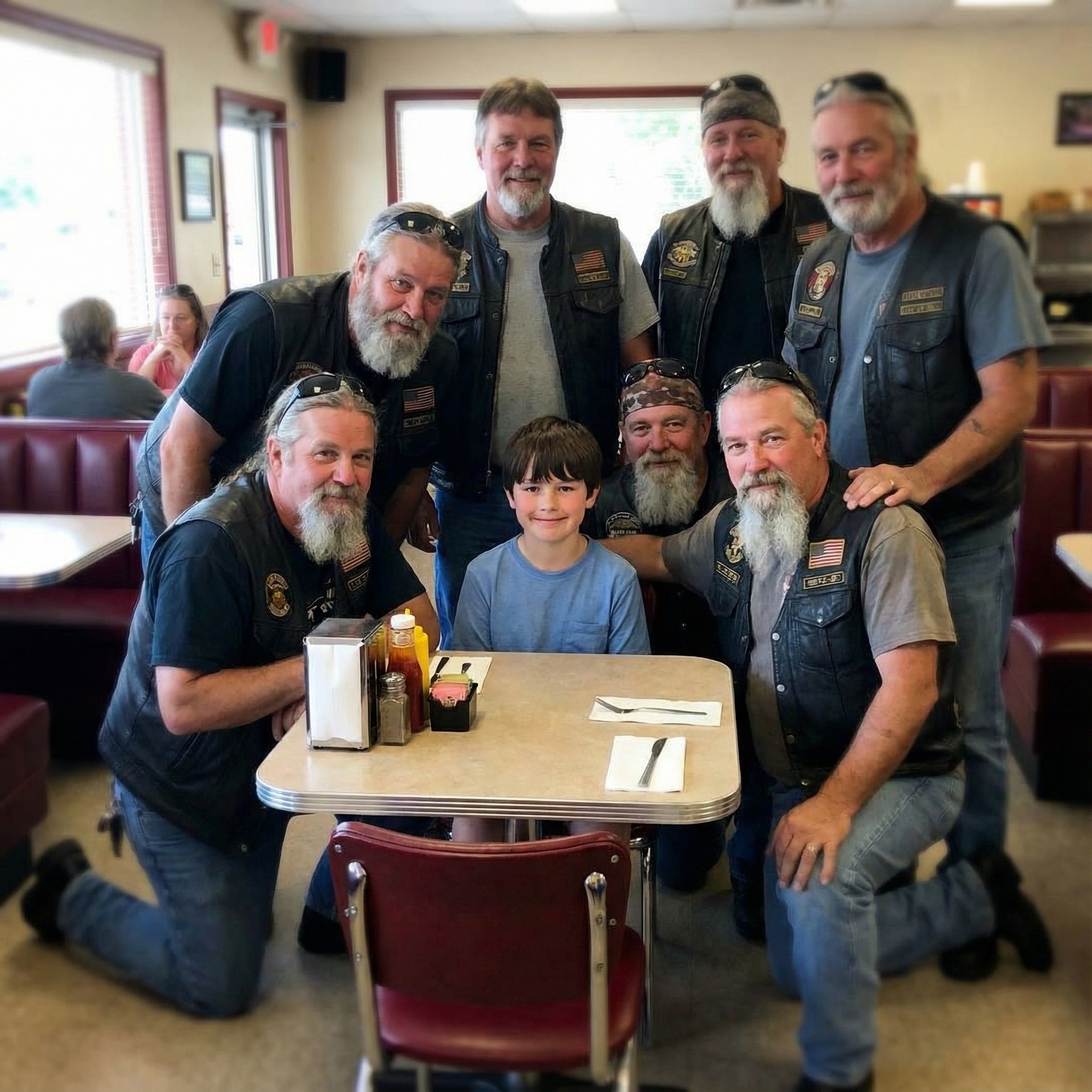
Marcus had been battling his stutter since he was four, and by nine years old he already understood more about cruelty than any child should. Some days the words came out smooth, other days they hit a wall and stacked up behind his teeth, leaving him red-faced and gasping for patience he hadn’t developed yet. Kids laughed. Adults hurried him. And every time someone mocked him, a little more confidence drained out of him.
That Saturday, we were three hours into a drive to my mother’s house when Marcus begged for food and a bathroom break. Rosie’s Diner sat off Highway 12, a neon sign buzzing above fifteen parked motorcycles. A swarm of leather, boots, and beards. I almost kept driving, but Marcus practically squirmed out of his seat.
“I r-really have to g-go, Mom.”
Inside, eight bikers had pushed three booths together. They were loud, laughing, the kind of men who filled a room naturally. I guided Marcus to a booth far from them and ordered pancakes for him—his comfort food, no matter the time of day.
While we waited, a family with three boys slid into the booth behind us. The mother kept her eyes glued to her phone while the boys bounced around like they’d been raised in the wild.
When Marcus needed the bathroom, he slid past their table and politely said, “E-excuse m-me.”
One boy snorted, “E-excuse m-me,” dragging out the fake stutter.
The other two howled with laughter.
Marcus froze, then bolted to the restroom, cheeks burning. I turned in my seat.
“That’s unacceptable,” I snapped. “Apologize. Now.”
Their mother finally looked up with an irritated sigh. “They’re just kids. Relax.”
“They’re bullying my child.”
“It was a joke. Maybe your son needs thicker skin.”
My jaw clenched, but arguing with someone that dismissive felt pointless. I forced myself to face forward and breathe.
When Marcus returned, he had to walk past them again—and this time, they were ready.
“W-w-want to play?” one taunted.
“W-what’s your n-name?” another said mockingly.
Then the third delivered the gut punch: “R-r-r-retard!”
The laughter that followed sliced through him. Marcus stopped right in the middle of the diner, shoulders shaking, tears streaming. His mouth opened, but nothing came out. Not one word.
And that’s when eight bikers stood up at the exact same moment.
The diner went silent. Even the waitress froze.
The biggest of them—a giant of a man with a beard like a waterfall—walked straight toward the boys’ booth. His boots hit the tile like hammer strikes. The boys’ mother straightened, fear replacing her earlier annoyance.
“Is there a problem?” she asked weakly.
He didn’t even acknowledge her. His eyes were locked on the boys.
“You think stuttering is funny?” he asked, voice low enough to vibrate the air.
The boys shook their heads violently.
“I asked you a question.”
“No, sir,” the oldest whispered.
“That man back there—” he pointed to another biker walking toward us, a gray-haired man with gentle eyes “—is my little brother. He’s had a stutter for sixty-two years. You want to mock him too?”
All three boys started crying.
Meanwhile, the gray-haired biker knelt beside Marcus.
“H-hey, buddy. I’m J-Jimmy,” he said softly, the stutter undeniable. “What’s your n-name?”
“M-Marcus,” my son whispered.
“That’s a g-great name,” Jimmy said, smiling. “I’ve had a st-stutter all my life. You know what I learned?”
Marcus shook his head.
“That the p-people who laugh at us? They’re scared. It takes m-more courage to talk with a stutter than it does to talk normal. Every word we push out is a w-win.”
Something in Marcus’s expression cracked open. He listened—really listened.
Jimmy pulled a small laminated card from his vest. A motorcycle emblem gleamed on it.
“This is an honorary G-Guardian card. We give it to s-special people. People who show courage. You’re one of them now.”
“You m-mean… I’m a Guardian?” Marcus whispered, eyes shining.
“You bet, buddy. And Guardians look out for each other.”
Across the diner, the big biker finally addressed the mother.
“Your sons called this child a retard. In public. And your response was to tell his mother to relax?”
Her face drained of color.
Another biker, the club chaplain, stepped up. “Ma’am, the way we treat the vulnerable is the truest measure of who we are. Your boys failed today. But so did you.”
By now the whole diner was silent, watching, absorbing every word.
Then something unexpected happened.
The oldest boy wiped his face, stood, and walked over to Marcus.
“I’m really sorry,” he mumbled. “My grandpa can’t talk right since his stroke. I shouldn’t have made fun of you.”
Marcus swallowed hard. Then he said, carefully but clearly, “It’s o-okay. Just d-don’t do it again. To anyone.”
The boy nodded and hurried back.
The bikers cheered quietly like they’d just witnessed something important.
And honestly—they had.
They moved their meals to the booths around us and spent the next hour talking to Marcus like he was one of them. Not a kid who struggled. Not a boy who stuttered. Just a person worth talking to. A kid whose words were worth waiting for.
Marcus talked more that hour than he had in months. Yes, he stuttered. Yes, some moments were slow. But they didn’t rush him. Not once.
When it was time to go, each biker shook his hand.
“Stay strong, little Guardian.”
“You ever need anything, you call us.”
“Your voice matters, brother.”
Jimmy hugged him tight. “You’re one of us now, M-Marcus.”
Marcus hugged him back with both arms. “Th-thank you.”
On the drive to my mother’s house, Marcus stared at his honorary Guardian card with a pride I had never seen in him before.
“Mom?” he asked softly.
“Yeah, baby?”
“T-they were the n-nicest people ever.”
“Yeah,” I said, looking back at the diner fading behind us. “Yeah, they really were.”
Six months later, Marcus still carries that card everywhere. He’s visited the Guardians clubhouse, helped with charity rides, and made friends who treat him with the dignity he deserves.
His stutter is still there. But the shame?
Gone.
Replaced by something stronger—self-worth.
Those bikers didn’t just stand up that day.
They lifted him up. And in doing so, they changed the entire trajectory of his life.
Marcus is proud of who he is now. Proud of how he speaks. Proud of the courage it takes to try again each day.
And every time he pulls out that Guardian card and tells the story—stutter and all—I remember one simple truth:
The world isn’t defined by the people who mock.
It’s defined by the people who stand.