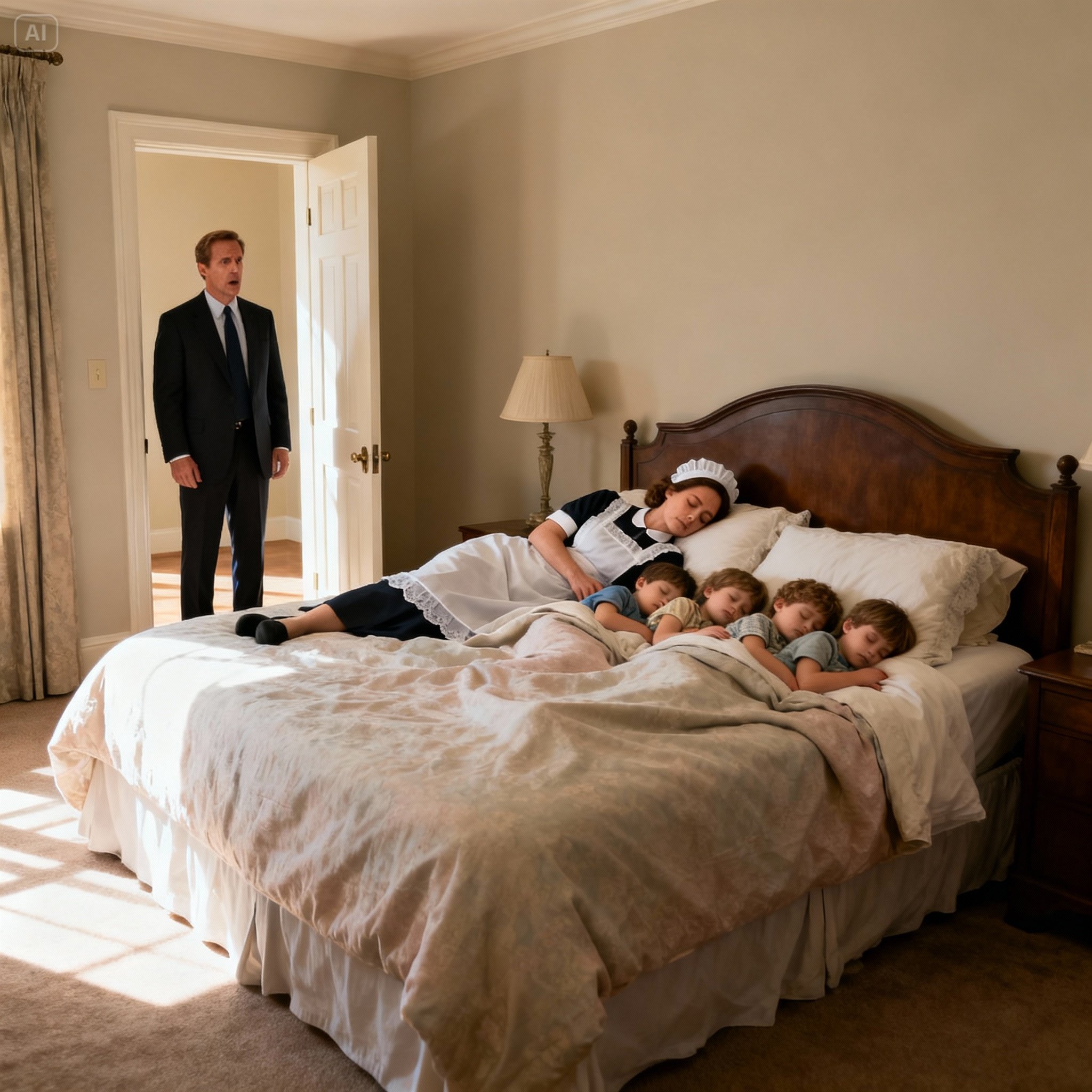
The House That Listened
Part 1
For nearly three weeks, the Whitaker estate in the hills above San Diego had been passed around domestic agencies like a whispered warning.
No one wrote dangerous on the paperwork. No one said the family was violent. No one used the kind of words that triggered liability or lawsuits. But the effect was the same: the phone calls stopped getting returned. The “available immediately” caregivers suddenly had doctor’s appointments, family emergencies, and long-lost cousins arriving from out of state.
And every woman who did accept the job left changed.
Some left crying.
Some left cursing.

One locked herself in the laundry room until security escorted her out with a face like she’d seen something that didn’t belong in a normal house.
The last one ran barefoot through the driveway at dawn, green paint dripping from her hair in long, wet strands. She screamed that the children were possessed and that the walls listened when you slept, and the gate clicked shut behind her taxi like the house itself had finally exhaled.
From the glass doors of his home office, Jonathan Whitaker watched the car disappear down the winding road.
He was thirty-seven. The youngest CEO ever interviewed on a late-night talk show for “making cybersecurity cool.” The founder of a firm now traded on the stock exchange. A man who could walk into any boardroom on the West Coast and have people stand up before he’d even said hello.
None of that mattered when he turned back to the house and heard something shatter upstairs.
The sound was sharp and sudden, like glass giving up.
Jonathan didn’t flinch anymore. Not outwardly.
He just stared for a beat at the reflection of himself in the darkened window—unshaven, eyes rimmed red, shoulders slightly caved in—then walked to the wall where the family photograph hung.
It had been taken four years earlier. The beach. Maribel laughing, hair blown by the wind, her skin sunlit and warm. Their girls crowded around her like puppies, clinging to her dress, sunburned and happy, all elbows and knees and joy.
Jonathan touched the frame with two fingers, careful, like the glass might break if he pressed too hard.
“I am failing them,” he said softly.
The room didn’t answer.
His phone rang.
He didn’t look at the screen, because he already knew who it would be.
“Steven,” Jonathan said, voice low.
Steven Lowell, his operations manager, spoke carefully, like a man walking across thin ice. “Sir… we’ve hit a wall.”
Jonathan’s jaw tightened. “Tell me.”
“No licensed nanny will accept the position. Not at that address. Legal advised me to stop calling—apparently some agencies started sharing notes.”
Jonathan closed his eyes for a moment. He could hear the house through the office door: faint footsteps, a distant laugh too high to be innocent, something dragging across a floor.
He exhaled slowly.
“Then we do not hire a nanny,” he said.
There was a pause on the other end. Steven didn’t argue, but he didn’t sound relieved either.
“There is one option left,” Steven said. “A residential cleaner. No childcare duties on record.”
Jonathan walked to the window and looked out at the backyard.
In daylight, it was beautiful in the way money always was—ocean in the distance, a terrace, a pool. But the yard looked like something had been torn through it. Toys lay broken among dead plants and overturned chairs. Plastic dolls with missing limbs. A small bicycle flipped on its side like it had been thrown. A swing seat twisted around its chains.
Jonathan stared at it the way you stare at a wound you keep reopening.
“Hire whoever says yes,” he said.
Steven hesitated. “Sir, I need to be clear. If she’s not trained in childcare—”
Jonathan cut him off, voice sharp for the first time. “I am trained in cybersecurity and I can’t protect my own home. Do you want me to keep pretending credentials matter here?”
Silence.
Steven swallowed. “No, sir.”
Jonathan’s voice softened, exhaustion leaking through. “Just… find someone who will walk through the door.”
“Understood,” Steven said. “We’ll offer triple pay.”
Jonathan stared at the backyard again.
“Offer whatever it takes,” he murmured, and ended the call.
Across town, in a narrow apartment near National City, Nora Delgado tightened her worn sneakers and shoved her psychology textbooks into a backpack that had seen better years.
Her apartment wasn’t tragic. It was just small. Clean, but cramped. A table that doubled as a desk. A couch that doubled as a bed when money got tight. A refrigerator with a tuition bill taped to the front like a threat.
Nora was twenty-six, with hair she kept tied back because loose strands got in the way of cleaning, of studying, of life. Her hands were always faintly dry from disinfectant. Her nails were short. Her posture was straight in that way people get when they’ve learned early that nobody’s coming to carry them.
She worked six days a week cleaning homes—some nice, some filthy, all of them belonging to people who could pay someone else to wipe up their mess.
At night, she studied child trauma by lamp light and tried not to think about her own past.
When she was seventeen, her younger brother died in a house fire.
She didn’t talk about it. Not because she’d forgotten, but because remembering felt like pressing a bruise. The fact stayed inside her like a stone: the scream of sirens, the smell of smoke, the moment she realized there are things you can’t fix, no matter how hard you try.
Since then, fear no longer startled her.
Silence didn’t frighten her.
Pain felt familiar.
Her phone buzzed.
An unknown number.
She answered anyway. “Hello?”
The agency supervisor sounded rushed, breathless. “Nora? It’s Camille from Harbor Home Services. Emergency placement. Private estate. Immediate start. Triple pay.”
Nora didn’t respond right away.
Triple pay meant rent. Tuition. Maybe replacing the cracked phone charger she’d been taping together for weeks.
But emergency placement usually meant one thing: someone else had said no.
“What’s the catch?” Nora asked calmly.
Camille hesitated, then spoke faster. “Residential cleaning. Big home. Family situation… complicated. No one is saying it’s unsafe. It’s just—” She stopped herself. “It’s immediate. They need someone today.”
Nora looked at the tuition bill on her refrigerator. The number stared back at her like a dare.
She didn’t ask for more details, not because she didn’t care, but because she understood the way agencies worked. If she asked too many questions, Camille might find someone else.
“Send me the address,” Nora said.
Camille exhaled like she’d been holding her breath. “Thank you. I’m emailing it now. You’ll be picked up at the gate. Just… keep your phone on.”
Nora hung up and stared at the screen for a second.
Then she opened her backpack again, checked that her textbooks were still there, and zipped it shut.
Because whatever waited behind that gate, she wasn’t going to stop being who she was.
A cleaner.
A student.
A woman who had already survived a fire.
The Whitaker house was beautiful in the way money always was.
Clean lines. Ocean views. Manicured hedges. A driveway that curved like it was designed for slow-moving luxury cars. A gate that opened only after a guard studied you like you might be a threat.
Nora pulled up in a rideshare car and watched the gate rise with a smooth mechanical hum. The driver glanced at her in the rearview mirror, then back at the guard.
“Fancy,” he muttered.
Nora didn’t reply. Her eyes were fixed on the property.
The guard leaned down toward her window once she rolled it open. He wore a uniform that looked too crisp for the kind of tiredness in his eyes.
“You Nora Delgado?” he asked.
“Yes.”
He nodded once, then murmured quietly, almost like an apology, “Good luck.”
The gate opened wider.
The rideshare rolled forward.
Nora felt the air change as they entered—cooler, quieter. The kind of quiet that came from distance, from wealth that bought separation from the noise of ordinary life.
But when the car stopped near the front entrance, and Nora stepped out, she felt something else too.
Not danger.
Absence.
The house didn’t feel lived in.
It felt haunted by what used to be there.
A man met her at the doorway.
Jonathan Whitaker.
He was tall, dressed in casual clothes that were expensive without trying to look expensive. His face held exhaustion like it had become a permanent feature. Dark circles under his eyes. A tightness around his mouth that suggested he’d been clenching his jaw for days.
“Ms. Delgado,” he said quickly, like he wanted to get through introductions before something else broke. “Thank you for coming.”
Nora nodded. “Mr. Whitaker.”
“The job is cleaning only,” Jonathan said immediately. “I want to be clear. You are not here as a nanny.”
A crash echoed overhead.
Then laughter—sharp, bright, edged enough to cut through the air.
Jonathan’s gaze flicked upward. He didn’t react to the sound, not outwardly, but Nora saw the way his shoulders tightened like a reflex.
“My daughters are grieving,” he said. “I cannot promise calm.”
Nora adjusted the strap of her backpack. “I am not afraid of grief,” she replied.
Jonathan studied her for a moment, as if trying to decide whether she meant it.
Then he stepped aside. “Come in.”
Inside, the house was even more beautiful—stone floors, art on the walls, a staircase that curved like something from a magazine. Everything polished.
And yet, the air felt thin.
Nora could smell cleaning products layered over something older, something sour that wasn’t dirt but stress.
A small toy skittered across the second-floor landing above them and bounced down a step. No one retrieved it.
Jonathan led her toward the kitchen. “Housekeeping supplies are in the pantry,” he said. “Security is on the property. If anything… if anything makes you uncomfortable—”
Nora held up a hand gently. “I’ll find you,” she said.
Jonathan nodded once, like he didn’t believe anyone would actually stay long enough to find him.
As they passed the base of the stairs, Nora felt eyes on her.
She looked up.
A line of girls stood watching from the staircase, clustered like they’d been waiting for her arrival.
Hazel, the oldest, around twelve. Her posture was rigid, shoulders squared like she’d appointed herself the adult in a house where the adults were failing.
Brooke, about ten, pulling at the sleeves of her shirt, her gaze flicking between Nora and Jonathan as if she couldn’t decide what she wanted to happen.
Ivy, nine, eyes darting too quickly, taking in every detail of Nora’s face, Nora’s shoes, Nora’s bag—like she was cataloging threats.
June, eight, pale and quiet, hands clasped so tightly her knuckles looked white.
Then the twins—Cora and Mae, six—standing too close together, smiling with too much intention. Smiling like they were already planning something.
And Lena, the smallest, three years old, clutching a torn stuffed rabbit like it was the only thing in the house that loved her back.
Jonathan paused, gaze softening for half a second. “Girls,” he said, voice tired. “This is Nora. She’s here to clean.”
Hazel stepped forward one step, chin lifted.
“You are number thirty-eight,” Hazel said flatly.
The words weren’t childish. They sounded like a report.
Nora didn’t flinch. She didn’t ask what Hazel meant. She didn’t make a big face of sympathy.
She simply nodded, like Hazel had told her the weather.
“Then I’ll start with the kitchen,” Nora said evenly.
The twins’ smiles twitched.
Ivy narrowed her eyes slightly, unsettled by the lack of reaction.
June looked down at her feet.
Lena stared at Nora with wide, silent eyes.
Jonathan rubbed a hand over his face. “Just… do what you can,” he murmured.
Nora turned away from the stairs and walked into the kitchen as if the house hadn’t just announced her replacement number.
She set her backpack down near a chair.
The kitchen was spotless on the surface. Marble counters. Stainless steel appliances. A fruit bowl arranged like a sculpture.
But Nora’s eyes caught the deeper signs.
A cabinet door hanging slightly crooked, like someone had slammed it repeatedly.
A faint smear of something sticky on the tile.
A trash bin overflowing despite the house’s cleanliness, like the staff had stopped caring.
And then she saw the refrigerator.
Photographs pinned to it with magnets—random, uncurated, real.
Maribel cooking, laughing at the camera.
Maribel asleep in a hospital bed holding Lena, face pale but peaceful.
Maribel sitting on the floor with the twins, paint on her hands, smiling like she didn’t care about mess.
Grief wasn’t hidden here.
It lived openly, like it had nowhere else to go.
Nora opened the pantry and found supplies exactly where Jonathan said. She set to work without ceremony, wiping counters, scrubbing the sticky smear from the tile, clearing the overflowing trash.
She moved steadily, methodically, letting the rhythm of cleaning do what rhythm always did—create a small order in chaos.
In a drawer near the stove, she found a handwritten note taped inside.
Banana Pancakes — Lena likes shapes.
(Heart, rabbit, dinosaur.)
— M
Nora stared at the note for a second.
Then she took it off carefully and set it on the counter.
Cleaning was the job.
But grief made its own rules in a house.
Nora opened the fridge, found bananas, flour, eggs. She worked quickly, quietly, following the note like it was a map left behind by someone who understood her girls would still be hungry even when the world fell apart.
She poured batter onto a pan and shaped pancakes into clumsy little animals.
Not perfect.
But recognizable.
When she finished, she plated them and set a plate at the kitchen table.
Then she walked away.
No announcement. No coaxing. No “come eat, sweetie” in a voice that begged for affection.
She left the food like an offering and returned to cleaning.
Ten minutes later, she heard tiny footsteps.
Nora glanced up.
Lena stood in the doorway, rabbit tucked under her arm, staring at the plate like it might disappear if she blinked.
Nora didn’t speak.
Lena climbed onto a chair carefully, pulled the plate closer, and began eating in silence.
Her eyes stayed wide the whole time, as if she couldn’t believe a good thing had happened without payment.
Nora wiped her hands on a towel and went back to work.
When she turned again, she saw the twins watching from the hallway, their smiles gone now, faces serious.
They’d expected her to beg. They’d expected her to flinch.
Instead, she’d fed their sister and ignored their test.
Mae whispered something to Cora.
Cora’s lips curved again—small, eager.
Trouble, Nora thought.
But she didn’t feel fear.
She felt readiness.
The twins struck first before lunch.
Nora rolled the mop bucket across the kitchen floor, and something bobbed near the surface of the water. At first she thought it was a toy. Then she saw the legs.
A rubber scorpion, detailed enough to make someone jump.
Cora and Mae stood behind the doorway, barely hiding their excitement, waiting for Nora to scream or drop the bucket or run.
Nora crouched and examined the scorpion closely, turning it in her fingers like a scientist.
“Impressive detail,” she said calmly.
The twins blinked.
Nora set the scorpion on the counter, exactly where they could see it. “But fear needs context,” she added, voice even. “You will have to work harder.”
She returned the scorpion to the bucket like it belonged there, dipped the mop, and kept cleaning.
Cora’s mouth fell open slightly.
Mae’s smile flickered and died.
They stared at Nora as if she’d spoken in a language they didn’t understand.
Good, Nora thought.
Unsettled kids are often kids who are finally being forced to see their own behavior clearly.
And clarity can be the first crack in a wall.
That afternoon, June had an accident.
Nora found it not through some dramatic confession but through a smell and a small, trembling figure standing in the hallway with wet pajama pants and eyes glassy with shame.
June’s voice shook. “Don’t tell,” she whispered.
Nora stepped closer slowly, keeping her hands visible, her voice gentle but not overly sweet.
“Fear confuses the body,” Nora said quietly. “We will clean quietly.”
June’s lower lip trembled.
Nora didn’t ask why.
She didn’t say, It’s okay, the way adults sometimes say it too brightly, too loudly, turning embarrassment into spectacle.
She simply walked June into the bathroom, helped her change into clean clothes without comment, stripped the bed, and started laundry.
When June sat on the edge of the tub, shoulders shaking, Nora handed her a folded towel.
June blinked hard. “You’re not mad?”
Nora met her gaze. “No,” she said.
June looked down, tears finally spilling. “Everyone else gets mad.”
Nora’s chest tightened, but she kept her voice steady. “I am not everyone else,” she replied.
June hugged the towel to her chest like it was armor.
From the top of the stairs, Hazel watched the entire scene without moving.
Nora could feel her gaze like weight.
The oldest wasn’t pranking.
The oldest was measuring.
That night, Nora lay on the small guest bed Jonathan had assigned her—clean sheets, expensive mattress, a room that felt like a hotel.
She opened her psychology textbook and tried to read, but the house kept speaking.
A faint thud upstairs.
A whisper of laughter.
A door shutting softly, then harder.
At one point, something shattered again, followed by a chorus of giggles that sounded too sharp to be happy.
Nora closed her book and stared at the ceiling.
She thought of her brother.
Fire.
Smoke.
The way fear used to rush through her body like a siren.
Now, in this expensive house that made other women run barefoot down the driveway, Nora simply breathed.
Silence did not frighten her.
Pain felt familiar.
Grief lived here openly, like a living thing.
And Nora had already decided something the moment Hazel said “number thirty-eight”:
She wasn’t going to compete with the house.
She was going to outlast it.
Down the hall, somewhere in the dark, a child began to cry.
Not loud.
Small.
As if crying too hard might wake a monster.
Nora got up without thinking.
Because cleaning was the job.
But staying—staying was the choice.
Part 2
Nora found the crying the way you find a loose board in an old floor—by listening with your whole body.
It wasn’t coming from the main hallway. It wasn’t dramatic. It was tucked away somewhere, soft enough that someone had learned to keep it small.
She moved quietly through the dark, barefoot so her steps wouldn’t announce her. The Whitaker house at night was its own creature—too big, too polished, full of corners that held echoes longer than they should.
The sound led her to a door halfway down the second-floor corridor.
Nora paused outside it.
She didn’t knock right away. She listened first—because barging into a child’s fear is a kind of violence too.
The crying hiccupped, then stopped abruptly, like someone had clamped a hand over their own mouth.
Nora spoke softly through the door. “It’s Nora.”
Silence.
Nora waited.
A whisper, almost too quiet: “Go away.”
Nora didn’t flinch. “Okay,” she said calmly. “I’m going to sit right here in the hallway.”
She lowered herself to the carpet outside the door, back against the wall, knees bent. She didn’t reach for the handle. She didn’t threaten to call anyone. She didn’t say, It’s okay. That phrase was often too big, too bright, too false.
Instead she stayed.
Minutes passed. The house settled. Somewhere far away a pipe clicked. The ocean air pushed against the windows.
Then, slowly, the door opened a few inches.
June’s face appeared in the gap—pale, hair messy, eyes swollen from tears.
Nora kept her gaze level, gentle, not pitying. “Hi,” she said.
June’s voice trembled. “I didn’t mean to cry.”
Nora nodded once. “I know.”
June stared at her, as if she was waiting for the part where Nora got annoyed or lectured her about waking people.
Nora didn’t.
Instead she asked, quiet and simple, “Do you want me in the room, or do you want me to stay in the hallway?”
June blinked, confused by the question.
Because most adults didn’t ask what children wanted when children were scared. Most adults decided.
June looked down, then whispered, “Hallway.”
Nora nodded. “Okay.”
She stayed where she was, back against the wall, breathing slow enough that her calm might leak under the door like warm air.
June opened the door a little wider and sat just inside it, hugging her knees, not crossing the threshold. Like she needed the distance to feel safe.
They sat like that in silence for a while.
Then June whispered, almost angry, “Everybody leaves.”
Nora’s throat tightened, but she kept her voice steady. “A lot of people have left,” she agreed.
June’s eyes flashed, sudden. “Because we’re bad.”
Nora turned her head slightly to look at her. “You’re not bad,” she said. “You’re hurt.”
June’s lips trembled. “Hazel says we scare them.”
Nora nodded once. “Hazel is trying to explain things she can’t control.”
June’s eyes dropped to the carpet. “Mom would’ve stayed,” she whispered.
There it was. The real sentence. The one that had been sitting behind all the pranks and the broken toys and the late-night crying.
Nora didn’t rush to fill the silence after it. She let it exist.
Then she said softly, “Your mom is still in this house.”
June looked up sharply. “No she’s not.”
Nora’s voice stayed calm. “Not like that,” she said. “But the way she loved you? The things she taught you? The small routines? Those stay. They don’t disappear.”
June stared at her as if she wanted to believe her but couldn’t afford it.
Nora leaned her head back against the wall again. “If you want,” she said quietly, “you can tell me one thing about your mom.”
June hesitated.
Then, in a tiny voice, she said, “She smelled like oranges.”
Nora smiled faintly. “That’s a good smell.”
June nodded, tears gathering again.
Nora didn’t wipe them. June could wipe her own tears. June needed power wherever she could find it.
They sat until June’s breathing slowed. Until her shoulders loosened.
When June finally whispered, “You can go now,” it didn’t sound like rejection.
It sounded like trust.
Nora stood slowly, careful not to move too fast. “Okay,” she said. “I’ll be in the kitchen in the morning.”
June watched her walk away.
Nora didn’t look back.
She didn’t need to.
Trust wasn’t a thing you grabbed. It was a thing you earned, one quiet hallway at a time.
Morning in the Whitaker house didn’t begin with sunlight.
It began with tension.
Nora woke before her alarm because she’d learned to. The house carried a low hum of anxiety, like a wire stretched too tight. She dressed quickly, tied her hair back, and walked into the kitchen.
Hazel was already there.
The twelve-year-old stood at the counter holding a cereal box, pouring too much into a bowl like she was angry at the bowl.
She didn’t look up when Nora entered.
Nora moved calmly, starting coffee, wiping a counter that didn’t need wiping. Creating rhythm.
Hazel finally spoke without turning. “June cried last night.”
Nora didn’t answer with surprise. “Yes.”
Hazel snapped, “And you didn’t tell Dad.”
Nora turned slightly. “Why would I?”
Hazel’s jaw tightened. “Because he doesn’t know anything. He doesn’t even know how we—” Her voice cracked, and she stopped hard, swallowing it back.
Nora watched her quietly. Hazel had been holding the house up on her thin shoulders for too long. That kind of responsibility turns children into little soldiers.
Nora said softly, “Your dad loves you.”
Hazel laughed once, bitter. “He loves his office.”
Nora didn’t argue. Arguing would make Hazel defend her bitterness, and bitterness was the armor Hazel needed right now.
Instead Nora asked, “Did your mom cook?”
Hazel froze.
Her fingers tightened around the cereal box.
Then she said quietly, almost against her will, “Banana pancakes.”
Nora nodded as if she’d expected it. “Shapes?”
Hazel’s eyes flicked to her. “How do you—”
Nora pointed at the fridge. “Your mom left notes.”
Hazel’s face shifted—something like grief, something like relief. She turned away quickly, pretending she needed to rinse her bowl.
Nora didn’t press.
She simply began making batter.
When the smell of banana hit the air, Brooke appeared in the doorway, hair messy, eyes cautious. Ivy hovered behind her, hands fidgeting at her sleeves. The twins followed, smiling again, but their smile looked different today—less mischievous, more curious.
Lena toddled in last, rabbit dragging on the floor.
Nora plated the pancakes and set them on the table.
She didn’t say, Come eat.
She didn’t beg them to sit like a cheerful camp counselor.
She just put food down and returned to cleaning.
One by one, the girls approached.
Even Hazel sat, stiff and guarded, like sitting down meant surrendering something.
The table felt like a small miracle—six children eating in the same room without shouting.
Nora watched from the sink, hands moving through dishes, letting the scene settle into the walls.
Because the house had been listening.
Now it would learn something new to hear.
The twins escalated.
Of course they did.
Cora and Mae weren’t cruel, not truly. Their chaos had a purpose. They were scientists of attention, testing boundaries the way children do when life has taught them boundaries don’t exist anymore.
That afternoon, Nora carried a basket of clean laundry upstairs.
Halfway down the hall, a loud crash sounded behind her—something falling, something shattering.
Nora didn’t jump. She didn’t run. She simply set the laundry basket down carefully and turned.
The twins stood in the doorway of the playroom, eyes bright, waiting.
Inside, a glass vase lay broken on the floor.
Nora looked at the pieces without reacting.
The twins waited for the explosion.
Nora tilted her head slightly. “That was expensive,” she said calmly.
Mae’s smile faltered.
Cora tried to hold her grin. “Oops.”
Nora nodded once. “Yes,” she agreed. Then she added, “Get the broom.”
Both twins blinked.
Mae frowned. “You’re not mad?”
Nora’s voice stayed even. “I’m not surprised,” she said. “But you will clean it.”
Cora’s mouth opened. “We don’t—”
Nora cut in gently. “You do now.”
The twins stared at her like she was speaking a foreign language.
Nora stepped around the broken glass and sat on the floor near the doorway, not close enough to risk getting cut, but close enough to make it clear she wasn’t leaving.
“You’re testing me,” Nora said calmly.
Mae’s face tightened. “No we’re not.”
Nora nodded as if she’d expected the denial. “Okay,” she said. “But if you were testing me, what would you be testing?”
The twins fell silent.
Children can’t hide forever when you ask the right question.
Cora’s eyes darted down. “If you’ll leave.”
Nora’s chest tightened.
Mae’s voice came out small. “Everybody leaves.”
Nora swallowed. “Yes,” she said. “A lot of people have left.”
Cora’s voice sharpened like she was angry at herself for saying the truth. “Because we make them.”
Nora shook her head once, slow. “You didn’t make your mom leave,” she said gently. “And you didn’t make other adults incapable of staying.”
Mae’s eyes glistened.
Nora kept her voice steady. “Get the broom,” she repeated softly. “Then we’ll clean.”
The twins didn’t move for a beat.
Then Mae disappeared down the hall, returning with a broom that was almost taller than her.
They swept the glass together, hands shaking slightly, and Nora helped them without scolding, without lectures.
When the last shard was in the dustpan, Nora stood and said, “Thank you.”
Cora stared at her. “That’s it?”
Nora nodded. “That’s it.”
Mae’s brow furrowed. “You’re weird.”
Nora smiled faintly. “I’ve been called worse.”
The twins watched her walk away like they weren’t sure what kind of adult she was.
Neither was Nora.
Not yet.
But she was staying.
Ivy’s panic episode happened on the fourth day.
It started small—a noise outside, maybe a car backfiring on the street below, or a door slamming somewhere in the house.
Nora was wiping down the kitchen counters when she heard Ivy’s breathing change—fast, sharp, uneven.
She turned and saw Ivy standing near the pantry, eyes wide, hand pressed to her chest like she was trying to hold her heart in place.
“No,” Ivy whispered. “No, no, no—”
Brooke looked up from the table, startled. “Ivy?”
Ivy shook her head, breathing harder. “I can’t— I can’t—”
Nora moved slowly, careful not to crowd her. She lowered her voice, keeping it calm and steady.
“Ivy,” Nora said softly. “Look at me.”
Ivy’s eyes flicked to Nora for half a second, then darted away.
Nora didn’t demand eye contact. She simply brought her own breathing into view—slow inhale, slow exhale—like she was showing Ivy a pattern.
“Feet,” Nora said gently. “Can you feel your feet?”
Ivy shook her head quickly, panic rising. “I’m gonna die.”
Nora’s voice stayed steady. “You’re not,” she said. “You’re having a panic wave. It feels like drowning. But it passes.”
Ivy’s breath hitched. Tears spilled. Her hands trembled.
Nora crouched a few feet away, not touching her. “Count with me,” she said. “Not numbers. Objects.”
Ivy stared at her, confused.
Nora pointed lightly. “Tell me one thing you can see.”
Ivy’s voice came out broken. “The… the chair.”
Nora nodded. “Good. One thing you can hear.”
Ivy swallowed. “The clock.”
Nora nodded again. “One thing you can feel.”
Ivy pressed her fingers to her sleeve. “My shirt.”
Nora’s tone stayed calm. “Good. Again.”
They did it again and again until Ivy’s breathing slowed, until the panic stopped climbing and started easing downward.
When Ivy finally sank to the floor, exhausted, she looked up at Nora with wet eyes.
“How do you know this?” Ivy whispered.
Nora’s chest tightened with a memory she didn’t speak aloud.
“Because someone once helped me,” she said quietly.
Ivy blinked, still shaking. “Who?”
Nora held her gaze. “A person who stayed,” she answered.
Ivy stared at her for a long moment.
Then, softly, like it was the most dangerous question in the world, Ivy asked, “Will you stay?”
Nora didn’t rush to promise forever. Children who’ve lost people don’t need grand promises—they need honest ones.
“I’m here today,” Nora said gently. “And I’ll be here tomorrow.”
Ivy’s shoulders loosened a fraction.
Brooke, watching from the table, whispered, “Nobody says that.”
Nora looked at her. “They should,” she replied.
That evening, Jonathan came home early for the first time in weeks.
Not early like he used to, when Maribel was alive and dinners were loud and normal.
Early like a man who didn’t know what else to do but stand in the doorway of his own home and witness what he’d been missing.
Nora heard the front door open and the quiet footsteps.
She didn’t announce him to the children. She didn’t warn them. She didn’t set up a performance.
She kept stirring the pot on the stove, letting the smell of dinner fill the kitchen.
The girls sat at the table—six bodies, six different kinds of tension, but together.
Hazel didn’t look up at the sound of her father’s steps. She stayed stiff, eyes on her plate.
Brooke’s hands rested near the piano book she’d started carrying again, though she hadn’t touched the keys in days.
Ivy ate slowly, still recovering from the panic episode, but present.
June sat quieter than usual, but she was eating.
The twins watched everything.
And Lena chewed silently, rabbit tucked beside her.
Jonathan stopped in the doorway.
He looked like a man who had walked into a scene from another life.
His eyes moved across the room, taking in the sight of his daughters eating in the same space without chaos.
Nora didn’t turn around at first.
She let him stand there.
Because sometimes parents need to feel the weight of what they’ve missed.
Finally, Jonathan spoke softly. “Hi.”
The girls didn’t respond. Not immediately.
Hazel’s shoulders tightened.
The twins glanced at each other.
Lena kept chewing.
Nora turned then, just enough to acknowledge him. “Dinner’s almost ready,” she said.
Jonathan nodded, eyes still on the table. “Thank you.”
The word sounded unfamiliar in his mouth. Like he didn’t use it enough.
He stepped closer, slow, careful, like he was approaching a wounded animal.
Hazel finally looked up. Her eyes were hard. “Why are you home?”
Jonathan flinched slightly. “Because… I want to be,” he said quietly.
Hazel’s lips pressed into a line. “You wanted to be at work before.”
Jonathan swallowed.
Nora kept stirring.
She didn’t rescue him.
She didn’t soften Hazel’s truth.
Hazel had earned her anger.
Jonathan’s voice was hoarse. “I know,” he said. “I’m sorry.”
Hazel stared at him like she didn’t know what to do with an apology from someone who had been absent for so long.
Then she looked away again, and the room returned to the quiet clink of forks against plates.
Jonathan didn’t force conversation.
He didn’t demand love.
He simply pulled out a chair near the end of the table and sat, hands folded, watching his daughters eat.
For the first time in a long time, he stayed.
Later, after the dishes were washed and the girls had drifted upstairs, Jonathan lingered in the kitchen.
Nora wiped down the counters, routine and steady.
Jonathan leaned against the doorway, eyes tired.
“What are you doing that I couldn’t?” he asked quietly.
Nora didn’t look up right away. She rinsed the sponge, wrung it out, placed it back neatly by the sink.
Then she turned to him.
“I stayed,” she said simply. “I didn’t ask them to heal.”
Jonathan’s eyes burned. He looked away fast, jaw tight.
Nora’s voice softened slightly. “They’re not trying to scare people for fun,” she added. “They’re trying to prove something.”
Jonathan swallowed. “What?”
“That everybody leaves,” Nora said.
Jonathan’s breath hitched.
Nora held his gaze. “And you can’t ask them to believe you’ll stay while you keep leaving.”
Jonathan nodded slowly, like the truth was heavy but necessary.
“I don’t know how to fix it,” he admitted, voice cracking.
Nora’s expression stayed calm. “Start with tomorrow,” she said. “And then the next day.”
Jonathan closed his eyes for a second, as if he were holding back tears.
When he opened them, he whispered, “Thank you.”
Nora nodded once. “Goodnight, Mr. Whitaker.”
Jonathan hesitated, then said softly, “Jonathan.”
Nora paused. Then nodded again. “Goodnight, Jonathan.”
He walked out of the kitchen slowly, like a man leaving a room that had finally stopped being a battlefield.
And behind him, the house listened.
But for once, it heard something new.
Not screaming.
Not shattering glass.
Not adults running away.
It heard someone staying.
Story Title: The House That Listened
Part 3
The Whitaker house didn’t become peaceful overnight.
It became quieter—and in a house like that, quiet was its own kind of miracle.
The yelling didn’t disappear completely. Toys still flew sometimes. Doors still closed too hard. The twins still looked for ways to bend reality just to prove they could.
But the chaos changed shape.
It stopped being a storm that swallowed everything.
It became something you could name.
Something you could move through.
And naming was the first step toward healing.
Nora didn’t call it healing yet. She knew better than to rush the word. Healing was a long road. Grief didn’t move like a straight line.
So she focused on the small things.
Routines.
Food.
Safety.
The steady repetition of ordinary moments that told a nervous system, You can breathe here.
Banana pancakes on mornings when Lena woke up crying.
Laundry folded the same way every time.
Dinner at the table—even if nobody talked much.
A lamp left on in the hallway so June wouldn’t freeze in fear when she woke at night.
Jonathan started coming home early more often.
Not every day—he still had meetings, still had a company that demanded him—but he began moving his schedule in ways that hurt his work and helped his children.
He sat at the table with them now, sometimes saying nothing, sometimes asking gentle questions that didn’t demand answers.
Hazel rarely responded. Hazel still held herself like a wall.
But Nora noticed that Hazel ate more when Jonathan was there.
Even if she didn’t look at him.
Even if she pretended not to care.
Children don’t stop needing their parents just because they’re angry.
Brooke returned to the piano on a Thursday afternoon.
It happened quietly.
Nora was in the hallway carrying clean towels when she heard it: a single note, tentative and soft, like a foot stepping onto thin ice.
Then another note.
Then a pause.
Then the first line of a simple song—slow, careful, almost shaking.
Nora stopped.
She didn’t move toward the piano room immediately. She didn’t announce herself. She stayed in the hallway and listened like the sound was sacred.
Brooke played with one finger at first, then two, the melody stumbling and restarting as if her hands didn’t fully trust themselves.
Nora heard the way Brooke’s breath caught between phrases. Heard the way she stopped suddenly, like she expected someone to laugh.
No one did.
When the song ended, the house held its breath.
Then Nora walked past the piano room doorway casually, towels in her arms, as if she hadn’t been listening.
Brooke sat at the bench, shoulders hunched, eyes fixed on the keys like they’d betrayed her once before.
Nora didn’t praise her. Praise could feel like pressure.
Instead Nora said simply, “That sounded like you.”
Brooke blinked, startled. “What?”
Nora kept walking. “Your mom would’ve known that was you,” she added softly.
Brooke’s lips trembled.
Nora didn’t stop. She didn’t make Brooke talk about it. She just let the sentence land and walked away.
Later, Nora noticed the piano lid was open again.
And again.
And by Sunday, Brooke was playing entire songs—still careful, still quiet, but real.
Jonathan stood in the hallway one evening listening, face tight, eyes wet.
When Brooke finished, he whispered, “That was beautiful.”
Brooke didn’t look at him. She stared at the keys and said, “Mom liked this one.”
Jonathan nodded like he couldn’t speak.
And in that small exchange, something shifted.
Not forgiveness.
But a crack in the wall.
The twins shifted too.
Not all at once. Not politely.
But noticeably.
Cora and Mae stopped hiding rubber insects in buckets. They stopped smashing things for the thrill of watching adults panic.
Instead, their pranks became… challenges.
Tests with rules.
One afternoon, Nora found the pantry shelves rearranged with labels written in marker: FLOOR CANDY. HUMAN FOOD. NOT HUMAN FOOD.
Nora stared at it for a long moment.
The twins stood behind her, eyes bright, waiting.
Nora turned slightly. “Explain.”
Mae pointed proudly. “So it’s easier.”
Cora added quickly, “And so you don’t get mad when you can’t find stuff.”
Nora’s throat tightened.
The twins didn’t know how to say, We want to help. They didn’t know how to say, Please don’t leave.
So they built puzzles and waited to see if Nora would solve them.
Nora nodded. “Good system,” she said calmly.
Mae’s smile burst wide. “Really?”
Nora reached up and straightened one label. “Really,” she said.
Cora bounced on her toes. “You like it?”
Nora glanced at them. “I like effort,” she replied.
They stared at her like she’d handed them a gift.
That night, Nora found two small drawings slid under her door.
Stick figures. A house. Six tiny shapes around a taller one.
Above it, in shaky letters:
STAY.
Nora stared at the drawings for a long time before she set them carefully on her nightstand.
She didn’t promise forever.
But she stayed the next day.
And the next.
June began sleeping through the night.
Not every night. But more.
When she did wake, she stopped hiding her crying. She would sit up and whisper for Nora instead of biting her own lip until she bled from keeping sound inside.
Ivy’s panic episodes lessened.
Not because Ivy stopped being afraid.
Because Ivy began trusting the fear would pass.
Nora taught her grounding techniques quietly—counting objects, describing textures, naming colors. Ivy clung to those tools like lifelines.
And Lena—little Lena—started laughing again.
Not big belly laughs at first.
Small giggles, like she was testing whether laughter was still allowed in a house that had been drowning.
One morning Nora found Lena in the hallway holding her torn stuffed rabbit.
The rabbit’s head was hanging by a thread.
Lena’s eyes were solemn. “Bunny’s broken,” she announced.
Nora crouched. “Can I fix him?”
Lena hesitated, then held the rabbit out with both hands like it was fragile.
Nora stitched the rabbit carefully with needle and thread from the sewing kit she’d found in the laundry room—Maribel’s sewing kit, still stocked like she might come back any second.
When Nora finished, the rabbit looked slightly crooked, but whole.
Lena hugged it tightly.
Then she looked at Nora and said, very seriously, “You fixed him.”
Nora’s chest tightened. She forced her voice steady. “Yes,” she said. “I did.”
Lena nodded like she was filing the information away.
Then, soft as a secret, she whispered, “Can you fix us?”
The words hit Nora like a punch.
Not because it was too much to ask.
Because it was exactly the question every grieving child carries, even when they can’t name it.
Nora swallowed, throat tight.
“I can’t fix what happened,” Nora said gently. “But I can help you feel safe while you grow.”
Lena stared at her, as if trying to understand.
Then she hugged the rabbit again and said, “Okay.”
That was all.
But it was enough.
Hazel was the last wall.
Hazel didn’t prank. Hazel didn’t cry openly. Hazel didn’t ask for comfort.
Hazel managed.
Hazel watched.
Hazel kept track of everyone’s moods like a war general.
She made sure June went to the bathroom before bed. She reminded Brooke to practice piano because “Mom would want it.” She pulled Ivy into corners when Ivy started spiraling, whispering sharp instructions like she was trying to save her sister by force.
The twins listened to Hazel more than they listened to anyone.
Hazel was twelve, but she moved like a second parent.
Nora saw it.
Jonathan saw it too, though he didn’t know what to do with it.
One evening, Jonathan stood in the kitchen while Nora packed leftovers into containers.
“I don’t recognize Hazel anymore,” he said quietly.
Nora didn’t look up. “Hazel is doing what you didn’t,” she replied.
Jonathan flinched.
Nora softened slightly. “She became the adult,” Nora said. “And she’s tired.”
Jonathan’s voice cracked. “How do I take it back?”
Nora capped a container and turned to him.
“You don’t take it back,” she said gently. “You earn it back. Slowly.”
Jonathan nodded, eyes wet.
That night, he tried.
He knocked on Hazel’s bedroom door.
No answer.
He knocked again. “Hazel,” he said softly. “Can I come in?”
Silence.
Jonathan stood there for a long moment.
Then Hazel’s voice came through the door, flat. “Why?”
Jonathan swallowed. “Because I miss you.”
A pause.
Then Hazel said, cold and precise: “You miss Mom. You just can’t get her back, so you’re trying us now.”
Jonathan’s face went pale.
He leaned his forehead against the doorframe, eyes closed.
“You’re right,” he whispered. “And I’m sorry.”
Hazel didn’t open the door.
But Nora heard something shift in the hallway.
A small crack.
Not forgiveness.
But honesty.
The illusion broke on a night that started almost normal.
Dinner had been quiet. Brooke played piano afterward. The twins had giggled over a board game with June. Ivy had sat at the table coloring. Lena had fallen asleep on the couch clutching her rabbit.
Jonathan stayed home. He didn’t take calls. He sat with them, present.
For the first time, the house felt like it was holding together.
Then, sometime after midnight, Nora woke to a sound she’d never heard before in the Whitaker house.
Not a crash.
Not a scream.
A silence that felt wrong.
Nora sat up in bed instantly, heart pounding—not from fear, but from instinct. The kind of instinct you develop when you study trauma and live in it.
She stepped into the hallway.
The nightlight glowed softly. The house smelled like lavender from the laundry detergent.
Everything looked calm.
Too calm.
Nora moved down the hall toward Hazel’s room.
Hazel’s door was closed.
But Nora could hear something faint behind it.
Not crying.
Not movement.
Breathing—slow and heavy, like someone sleeping too deep.
Nora’s stomach dropped.
She knocked once. “Hazel?”
No answer.
Nora tried the handle.
Unlocked.
She pushed the door open carefully.
Hazel lay on her bed, face pale, lips slightly parted. Her eyes were closed, but not in normal sleep. Her body looked too still.
On the nightstand, an open bottle of pills.
Nora felt the world sharpen into one point of urgency.
She rushed to Hazel’s side and pressed two fingers to her neck.
A pulse.
Weak, but there.
Nora’s hands moved fast, trained by study and terror.
She grabbed Hazel’s shoulder gently but firmly. “Hazel,” she said loudly. “Hazel, wake up.”
Nothing.
Nora’s throat tightened.
She ran into the hallway and shouted, voice cutting through the house like a blade.
“Jonathan!”
Footsteps thundered. A door flew open. Jonathan appeared in the hall, hair disheveled, eyes wild.
“What—”
Nora didn’t waste time. “Hazel took pills,” she said. “Call 911. Now.”
Jonathan froze for half a second—the kind of freeze that happens when the brain refuses reality.
Then he moved.
He sprinted toward Hazel’s room, shoving past Nora, and when he saw his daughter on the bed, his face crumpled like he’d been punched.
“No,” he whispered. “No, no—Hazel—”
Nora grabbed his arm hard. “Call,” she repeated.
Jonathan fumbled for his phone like his fingers didn’t belong to him. He dialed with shaking hands.
Meanwhile, Nora turned Hazel onto her side, keeping her airway clear, murmuring steady instructions out loud the way you do when panic tries to steal your thinking.
“Breathe, Hazel,” Nora whispered. “Stay with me.”
Jonathan’s voice was hoarse on the phone. “My daughter—she—she took pills—please, please send an ambulance—”
The commotion woke the house.
Brooke appeared in the hallway, eyes wide. Ivy followed, shaking. June stood behind them clutching a blanket. The twins huddled together, faces pale. Lena began crying loudly, startled awake by the chaos.
Nora glanced back and said firmly, “Go to the living room. All of you. Stay together.”
Hazel’s sisters moved like frightened animals, clinging to each other as they retreated.
Jonathan dropped to his knees beside the bed, trembling. His hands hovered over Hazel’s face like he didn’t know if touching her would break her.
“I’m here,” he whispered. “I’m here, baby, please—”
Hazel didn’t respond.
Nora stayed steady. She watched Hazel’s breathing, watched her pulse, watched the seconds crawl.
Sirens finally wailed in the distance.
Then closer.
Then lights flashed through the window.
Paramedics rushed in, efficient and fast. Questions. Equipment. IV lines. A stretcher.
Jonathan stumbled back as they lifted Hazel carefully.
His face had gone gray.
He followed them down the stairs like he was walking through a nightmare.
Nora stayed close—not touching him, not pushing him, just present.
In the living room, the other five girls clung together on the couch, eyes huge and wet.
Brooke whispered, “Is she dying?”
Nora swallowed, forcing her voice calm. “They’re helping her,” she said. “She’s not alone.”
That night, the Whitaker house emptied into the cold brightness of ambulance lights.
And Jonathan—who had been holding himself together with a CEO’s controlled face—finally broke.
At the hospital, under fluorescent lights, he collapsed into a plastic chair in the waiting room and bent forward with his head in his hands.
He cried.
Not polite tears.
Not the kind you wipe away quickly.
The kind that shakes your whole body. The kind you can’t hide.
Nora sat beside him, silent and present.
Jonathan’s voice cracked. “I failed her,” he whispered. “I failed all of them.”
Nora didn’t rush to comfort with lies.
She said softly, “You’re here now.”
Jonathan shook his head violently. “It’s too late.”
Nora’s gaze stayed steady. “It’s not,” she said quietly. “But it is real. And you can’t pretend anymore.”
Jonathan sobbed harder.
Nora stayed.
Because healing doesn’t begin when everything is fixed.
Healing begins when the truth finally has room to breathe.
Part 4
Hazel survived.
Not because life suddenly became kind, and not because the universe decided the Whitakers had suffered enough. She survived because Nora noticed the wrong kind of silence, because Jonathan’s hands finally did something besides hold a phone, because paramedics arrived fast, and because the hospital staff moved with the practiced urgency of people who had seen too many children try to leave the world.
Hazel survived—barely.
In the pediatric ICU, she lay with tubes and monitors and a grayness in her skin that made Jonathan’s heart feel like it was being squeezed in a fist. The doctors spoke in measured sentences: “stable,” “responding,” “we’ll know more in the morning.”
Morning took forever.
In the waiting room, the Whitaker sisters shifted from panic into something quieter and more dangerous: guilt.
Brooke kept whispering, “I should’ve known.”
Ivy stared at her hands and repeated, “I should’ve stayed with her.”
June didn’t speak at all. She just curled into herself, clutching a hospital blanket like it was the only solid thing left.
The twins—Cora and Mae—stayed too still, their eyes tracking everything. They looked frightened in a way Nora hadn’t seen before. Their chaos had always been loud; now their fear was silent.
And Lena—little Lena—kept asking for her mother.
Not in long sentences. Just the same broken question over and over:
“Where Mama?”
Jonathan couldn’t answer. Not without falling apart again.
Nora answered instead, softly, with the truth a three-year-old could hold.
“Mama isn’t here, sweetheart,” Nora told her. “But you’re safe. And Hazel is being helped.”
Lena clung to her rabbit and cried until she fell asleep against Nora’s side.
Jonathan watched that—watched Nora keep his youngest calm while his own hands shook—and he finally understood something that hurt worse than grief:
He hadn’t just lost Maribel.
He had lost the way the house used to function around her. The warmth, the center, the gravity that kept their six daughters from spinning out into the dark.
And he had tried to replace that gravity with money and staff and “best efforts,” as if love could be subcontracted.
Now, sitting under fluorescent lights with his daughters huddled around him like frightened birds, he understood the ugly truth:
He couldn’t outsource presence.
When Hazel woke, it wasn’t dramatic.
No movie moment, no sudden miracle.
Her eyes opened slowly, heavy-lidded, confused. Her throat was dry. The room smelled like sterile plastic and hospital air.
Jonathan was asleep in a chair beside her bed, head slumped forward, tie loosened, face streaked with dried tears. His phone lay on the floor under the chair as if it had slipped out of his hand at some point and he’d been too exhausted to care.
Nora was there too.
Not sleeping—just sitting, calm, her hands folded in her lap, eyes on Hazel.
Hazel’s gaze found Nora first.
For a moment, her eyes held suspicion, old and automatic. Even half-conscious, Hazel was still Hazel. Still guarded.
Then her face shifted—tiny, barely visible.
Relief.
Hazel’s lips moved, but no sound came out at first. Her voice was a whisper when it finally arrived.
“Why… are you… here?”
Nora leaned forward slightly, keeping her voice soft. “Because you’re awake,” she said. “And you’re not alone.”
Hazel blinked slowly, as if she was trying to decide whether to believe it.
Then her eyes drifted to Jonathan slumped in the chair.
Hazel stared at him for a long time.
Something complicated moved across her face—anger, sadness, recognition.
She whispered, “He stayed.”
Nora nodded. “Yes,” she said. “He did.”
Hazel’s eyes filled, but the tears didn’t fall. Hazel had spent too long holding herself together to allow tears to spill easily.
She looked back at Nora and whispered, almost accusing, “You told him.”
Nora held her gaze. “I told him the truth,” she said. “And you did too, in your own way.”
Hazel’s jaw tightened. “I didn’t want to die.”
Nora’s throat tightened, but she kept her voice steady. “I know,” she said. “You wanted the pain to stop.”
Hazel stared at the ceiling. Her voice came out thin. “It didn’t stop.”
Nora didn’t lie. “Not yet,” she said gently. “But it can change.”
Hazel swallowed with difficulty.
Jonathan stirred in his chair, sensing movement the way parents do even in sleep. His head jerked up.
His eyes found Hazel.
For a second, his face was blank with disbelief. Then it crumpled.
“Oh—baby—” His voice broke.
He grabbed Hazel’s hand with shaking fingers, afraid to squeeze too hard, afraid she’d disappear if he touched her wrong.
Hazel watched him closely.
Jonathan’s eyes spilled immediately. “I’m sorry,” he whispered. “I’m so sorry.”
Hazel didn’t pull her hand away.
That was the first miracle.
The doctors were clear: Hazel’s body would recover faster than her mind.
They said words like “acute crisis” and “suicidal ideation” and “grief-related trauma.” They said Hazel needed evaluation, therapy, close monitoring. They said the family needed support too, because Hazel hadn’t acted in a vacuum—she’d been carrying a whole house on her back.
Jonathan nodded through it all, face pale, eyes hollow, as if he were finally hearing the language of what had been happening upstairs every time something shattered.
Nora stayed through the meetings, not speaking unless she was asked. Not inserting herself into family decisions. Just present—steady enough that the room didn’t tilt.
When the social worker asked Jonathan, “Do you have a support system?” Jonathan’s gaze flicked to Nora without thinking.
Then he looked away quickly, embarrassed by how much he needed her.
But he answered honestly.
“I’m building one,” he said.
That was new.
Before, Jonathan Whitaker would’ve said, “We’re fine.”
Now he said, “I’m building one.”
It sounded like accountability.
Back home, the house felt different after the hospital.
Not lighter. Not yet.
But exposed.
Like someone had finally pulled back a curtain and admitted how cold the room was.
Jonathan didn’t go back to his office the next day.
Or the day after.
Steven called, voice tense, reminding him of meetings and shareholders.
Jonathan’s answer was quiet and final. “Reschedule,” he said. “Or cancel. My daughter almost died.”
Steven hesitated. “Sir—”
Jonathan’s voice sharpened slightly. “Do you want a CEO who can protect servers but can’t protect his children?”
Silence.
Steven’s voice softened. “Understood, sir.”
Jonathan hung up.
Then he did something Nora hadn’t seen him do in weeks:
He walked into the living room and sat down on the floor with his daughters.
Not hovering. Not pacing. Not checking email.
Just… sitting.
Hazel wasn’t home yet—she stayed at an inpatient program for evaluation first, with hospital staff teaching Jonathan what to look for and how to respond instead of panicking.
But the other five girls were there, clustered near Jonathan like they didn’t trust the floor to hold them.
Brooke played with a loose thread on a cushion, eyes down. Ivy hugged her knees, breathing shallow. June leaned against the couch like she might melt into it. The twins sat cross-legged too still. Lena crawled into Jonathan’s lap and pressed her face into his shirt.
Jonathan held her, eyes closing briefly as if he needed to feel her breathing to believe she was real.
“I’m not going anywhere,” he said quietly.
No one answered.
He repeated it anyway, slower, firmer: “I’m not going anywhere.”
Ivy’s voice came out thin. “You always go.”
Jonathan’s throat tightened. “I know,” he admitted. “And I’m sorry.”
The twins stared at him like he’d spoken a strange word.
Brooke whispered, “Mom would’ve stayed.”
Jonathan nodded, eyes wet. “Yes,” he said. “She would have.”
Silence fell.
Then Jonathan said the sentence Nora knew he’d been avoiding because it hurt too much to hold in his mouth.
“I can’t bring her back,” he whispered. “But I can stay now.”
June’s lips trembled. “We don’t know how.”
Jonathan swallowed. “Me neither,” he admitted. “So we’re going to learn.”
He looked toward Nora, standing quietly near the doorway.
“Right?” he asked softly.
Nora didn’t step in to parent his children. She didn’t take over.
She just nodded once. “One day at a time,” she said.
Jonathan nodded back like he was holding onto a rope.
When Hazel returned home weeks later, she looked smaller.
Not physically—Hazel was tall for twelve—but smaller in the way trauma can shrink even the strongest child. Her eyes were tired. Her posture wasn’t rigid anymore; it was cautious.
She didn’t walk in like a captain returning to her ship.
She walked in like someone who wasn’t sure the ship wouldn’t sink again.
Jonathan met her at the door and knelt, keeping his voice gentle.
“I’m glad you’re home,” he said.
Hazel stared at him as if she didn’t know what to do with tenderness from a parent who had been absent for so long.
Nora stood back, giving space. This was Jonathan’s moment to earn.
Hazel finally said, “Don’t pretend.”
Jonathan’s face tightened. “I won’t,” he promised.
Hazel’s gaze flicked past him into the house. The living room was cleaner. The sharp edges of chaos had been softened—lamps on, blankets folded, toys organized instead of smashed.
The piano room door was open.
Brooke was on the bench, fingers hovering over the keys but not playing yet, waiting.
The twins stood behind June, unusually quiet.
Ivy watched Hazel like she was afraid to breathe.
Lena clutched her rabbit and whispered, “Hazel.”
Hazel stepped inside.
And for the first time, she didn’t have to lead.
She simply existed.
That was the second miracle.
Therapy began like work.
Not like magic.
Family sessions. Individual sessions. Learning to name feelings instead of throwing them like weapons. Learning how grief hides inside behavior. Learning that anger is often fear wearing a loud mask.
The twins were the hardest at first. They didn’t want to talk. They wanted to perform.
But when the therapist asked, “What do you fear will happen if you’re calm?” Mae whispered, “If we’re calm, nobody looks at us.”
Cora added, “If nobody looks at us, we disappear.”
The room went quiet.
Jonathan’s face crumpled.
Nora sat still, heart heavy. She’d known it. But hearing it out loud made it real in a new way.
Brooke admitted she stopped playing piano because it felt like inviting happiness was “betraying Mom.”
Ivy admitted she couldn’t breathe sometimes because she felt like the house was “waiting for the next bad thing.”
June admitted, very softly, that she wet the bed because she was scared to sleep.
Hazel didn’t speak much at first. Hazel watched, listened, measured.
Then one day, in a family session, Hazel said quietly, “I thought if I kept everyone together, nobody would die.”
Jonathan’s breath hitched.
Hazel stared straight ahead and added, voice flat but trembling underneath, “I was wrong.”
Jonathan reached for her hand.
Hazel let him.
And in that small gesture, the house shifted again.
Nora’s own life didn’t pause through all this.
She still cleaned. Still studied. Still carried her textbooks like they were the key to a door she’d been pushing against for years.
At night, after the girls were asleep, Nora sat at the kitchen table with her notes spread out, reading about trauma responses and attachment and grief.
Sometimes Jonathan would walk in quietly and see her there, eyes tired but focused.
“You’re still studying,” he said once, almost in awe.
Nora didn’t look up. “Always,” she replied.
Jonathan hesitated. “Why?”
Nora’s fingers paused on the page.
She thought of her brother. The fire. The helplessness.
Then she said simply, “Because I don’t want to watch children burn and not know what to do.”
Jonathan’s face tightened. He nodded slowly, as if he finally understood that Nora wasn’t fearless.
She was trained by loss.
Months later, Nora graduated with honors.
She didn’t want a big celebration. She didn’t want attention.
She just wanted the degree in her hands like proof that her past didn’t get to decide her future.
But the Whitaker family insisted.
They filled the front row of the auditorium—six girls dressed neatly, Jonathan in a suit he didn’t care about, all of them sitting close together like they’d learned how to be a unit again.
When Nora walked across the stage, Hazel stood first.
Then Brooke.
Then Ivy.
Then June, the twins, and Lena clapping with small hands, rabbit tucked under her arm.
Jonathan’s eyes were wet.
Nora’s throat tightened so hard she nearly missed her step.
Afterward, outside under a flowering jacaranda tree, the girls crowded around her.
Hazel stayed slightly apart, as she always did, but her eyes were soft in a way Nora hadn’t seen before.
Hazel spoke quietly, voice steady.
“You did not replace her,” she said.
Nora’s chest cracked open.
Hazel continued, “You helped us survive her absence.”
Nora’s eyes filled instantly.
“That is enough,” Nora whispered, and this time she didn’t try to stop the tears.
Jonathan stepped closer then, reaching for Nora’s hand—careful, respectful, not claiming.
Nora let him hold it.
Not as romance, not as rescue—just as a human gesture under a jacaranda tree in sunlight.
Because love wasn’t just what Maribel had left behind.
Love was what stayed longer.
And the house that once chased everyone away had become a home again.
Grief remained.
But now, so did people.
Part 5
By the time the jacaranda tree bloomed again, the Whitaker house had learned a different kind of sound.
Not the sharp laughter that used to slice through the hallways. Not the crash of glass that made every adult flinch. Not the frantic footsteps of another worker fleeing down the driveway with terror in her eyes.
Now the house heard quieter things.
A kettle whistling in the morning.
Piano notes—still careful, but steady.
A bedtime story read out loud, not rushed, not interrupted by a ringing phone.
Sometimes, in the middle of the night, the house still heard crying. But it wasn’t the trapped, secret crying anymore—the kind that had to be swallowed before it angered someone or embarrassed someone.
Now it was the kind of crying that came with a knock on the door.
“Can I come in?” Jonathan would ask softly.
And the answer, more and more often, was yes.
Healing wasn’t a straight line. It never was. It didn’t erase what happened to Maribel, and it didn’t erase what happened to Hazel that night.
It didn’t erase the weeks of chaos when the Whitaker girls tried to prove what they believed: that everybody leaves.
Healing simply did one thing—slowly, stubbornly.
It changed the meaning of staying.
Hazel’s return to school was the hardest milestone.
She didn’t want pity. She didn’t want people whispering. She didn’t want teachers watching her like she might shatter.
Jonathan tried to treat the first morning like a normal morning—breakfast, lunch packed, hair brushed, keys grabbed.
But nothing about it felt normal.
Hazel stood by the front door with her backpack on, shoulders rigid again, like she’d pulled her armor out of storage.
June hovered nearby, chewing her lip.
Ivy stared at the floor, breathing too shallow.
The twins were unusually quiet.
Brooke sat on the bottom step, hands clasped, eyes shiny.
Lena clutched her rabbit.
Jonathan knelt in front of Hazel, keeping his voice gentle. “Do you want me to drive you?” he asked.
Hazel’s jaw tightened. “No.”
Jonathan nodded once. “Okay.”
Hazel hesitated, then added, almost like it cost her, “Just… don’t make it weird.”
Jonathan swallowed hard. “I won’t.”
Hazel’s gaze flicked toward Nora—who was standing near the kitchen doorway, not interfering, not taking over, just present like always.
Nora met Hazel’s eyes.
No pity.
No fear.
Just steady.
Hazel held her gaze for a beat, then nodded once, sharp.
It wasn’t a thank you.
But it was acknowledgement.
And for Hazel, that was huge.
When the door closed behind her, the house held its breath.
Jonathan exhaled slowly, hand still on the doorknob.
Then he turned back to the other five girls and said, “All right. Pancakes?”
The twins blinked, startled. “Shapes?” Mae asked quietly.
Jonathan nodded, voice rough but determined. “Shapes.”
Brooke’s mouth trembled into the smallest smile.
Nora stepped forward and began mixing batter without comment.
And the house heard something else now—laughter that didn’t cut.
Laughter that warmed.
Jonathan changed his life the way people like him changed things: with structure.
He couldn’t undo Maribel’s death. He couldn’t undo Hazel’s attempt. He couldn’t erase months of chaos.
But he could change his days.
He moved his office schedule. He limited travel. He stopped taking calls during dinner. He put family sessions and individual therapy on his calendar like they were board meetings—because in a way, they were. They were about survival.
Steven called once, frustrated, talking about investors, deadlines, optics.
Jonathan’s response was quiet and final. “My children’s lives are not negotiable.”
Steven didn’t argue again.
Jonathan also did something else—something Nora hadn’t expected.
He stopped trying to be perfect.
He admitted when he didn’t know what to do.
One night, after a family session left everyone raw, Jonathan found Nora in the kitchen cleaning up dinner plates.
He leaned against the counter, eyes exhausted.
“I used to think if I made enough money, they’d be safe,” he said quietly.
Nora rinsed a plate, calm. “Money keeps some dangers out,” she replied. “But it doesn’t make grief smaller.”
Jonathan swallowed hard. “Maribel handled everything,” he admitted. “And I didn’t notice until she was gone.”
Nora dried her hands and looked at him fully.
“You noticed,” she said. “You just noticed late.”
Jonathan’s eyes flinched at that—painful but true.
Nora softened slightly. “Late is still better than never,” she added.
Jonathan’s shoulders sagged, relief and grief tangled together. “I don’t deserve them,” he whispered.
Nora’s voice stayed steady. “Deserving isn’t the point,” she said. “Showing up is.”
Jonathan nodded slowly.
And then he did what he’d been learning to do:
He went upstairs.
He knocked on Hazel’s door.
And when she said nothing, he stayed in the hallway anyway.
Not forcing.
Not leaving.
Just present.
The counseling center began as an idea on a piece of paper.
Jonathan brought it up one afternoon while Nora was studying at the kitchen table, textbooks open, highlighter in hand. The girls were outside in the backyard—still messy, but less destroyed—June and Ivy drawing chalk on the patio, the twins chasing each other, Lena carrying her rabbit, Brooke sitting near the piano room window reading.
Hazel was upstairs doing homework.
Jonathan sat across from Nora with a folder.
“I want to do something,” he said quietly.
Nora looked up. “What kind of something?”
Jonathan slid the folder across the table. On the cover were typed words:
Maribel Whitaker Center for Grieving Children
Nora’s chest tightened. She stared at the page.
Jonathan’s voice was careful. “I keep thinking about what you said,” he continued. “That I can’t ask them to heal. I have to stay while they do. But I also keep thinking about the other families. The ones who don’t have money. The ones who don’t have someone like you walking into their house.”
Nora’s throat tightened. “Jonathan—”
He held up a hand gently. “Not as charity optics,” he said quickly, like he knew the trap he could fall into. “Not as a headline.”
He swallowed, eyes shining. “As a place that would’ve helped us. As a place Maribel would’ve wanted.”
Nora stared at the folder, remembering the photos on the fridge. Maribel cooking, laughing, holding Lena in a hospital bed.
“She would,” Nora whispered.
Jonathan nodded. “I want it to exist in her name,” he said. “Not to replace her. But to extend her.”
Nora let out a slow breath.
“Do you want me involved?” she asked carefully.
Jonathan hesitated, then spoke with quiet sincerity. “I want you to have your own life,” he said. “I want you to be whatever you choose.”
Then he added, voice softer, “But if you want to help us build it—yes.”
Nora’s eyes burned.
She looked down at her textbooks.
Child trauma. Grief. Attachment.
Everything she’d studied wasn’t abstract anymore.
It was this family. It was Hazel. It was June wetting the bed. It was Ivy’s panic waves. It was the twins’ fear of disappearing. It was Lena asking for Mama. It was a house that listened.
Nora nodded slowly. “Then we build it right,” she said.
Jonathan’s shoulders loosened, relief flooding him.
Outside, the twins shrieked with laughter, and for once it sounded like childhood instead of warfare.
On the day the counseling center opened, it was small and simple.
Not a glossy ribbon-cutting with cameras everywhere.
Just a building near town with light-filled rooms, soft chairs, art supplies on shelves, and a sign on the front door that read:
You are allowed to miss them.
Families came in quietly at first. Some looked nervous. Some looked exhausted. Some held children’s hands too tightly.
Nora watched from the doorway as a little boy clung to his dad’s leg, eyes wide, face guarded.
She recognized the posture.
Jonathan stood near the reception desk, not as CEO, not as public figure, just as a father who had learned what grief could do to children when nobody stayed.
Hazel walked in beside him.
Older now. Still guarded, but different. She had a calmness in her eyes that wasn’t rigid anymore.
Brooke followed, then Ivy, then June, then the twins, then Lena with her rabbit.
The Whitaker girls didn’t say much.
But they were there.
And their presence said what words couldn’t:
We survived. You can too.
Under the jacaranda tree that afternoon, after the last guest had left and the new building had fallen into quiet, Jonathan found Nora outside.
The purple blossoms drifted down like soft confetti. The air smelled like spring and salt from the distant ocean.
Nora stood with her hands in her pockets, eyes shining, overwhelmed in the way you get when something you helped build becomes real.
Jonathan stepped closer.
“Thank you,” he said quietly.
Nora swallowed. “You did the work,” she replied. “I just… stayed long enough to help you see it.”
Jonathan’s voice was rough. “That’s a lot,” he said.
Nora looked away, tears rising. “It didn’t feel like a lot,” she whispered. “It felt like what my brother needed. And what nobody could give him.”
Jonathan’s face tightened with compassion.
He didn’t push. He didn’t ask questions she didn’t want to answer.
He simply reached out and took her hand—careful, respectful, not claiming.
Nora let him.
Hazel stepped out onto the patio behind them, hands tucked into the sleeves of her sweater.
She watched them for a moment, then walked closer, stopping a few feet away.
Her voice was quiet.
“You didn’t replace her,” Hazel said.
Nora’s chest cracked open again, tears spilling freely now.
Hazel continued, gaze steady. “You helped us survive her absence.”
Nora nodded, unable to speak.
Hazel’s mouth trembled slightly. “I thought everybody leaves,” she admitted. “And you proved I was wrong.”
Nora’s voice came out broken. “That is enough,” she whispered.
Hazel nodded once, firm, like she was sealing the truth.
Behind her, the other girls appeared—Brooke, Ivy, June, the twins, and Lena—gathering slowly under the jacaranda tree like it was the safest place in the world.
Jonathan looked at his daughters, then at Nora, and for the first time since Maribel died, he let himself believe something without fear.
Not that the pain would vanish.
But that love could outlast it.
The Whitaker house—once blacklisted, once full of shattering glass and screaming adults—had become a home again.
Grief remained.
But love stayed longer.
And the walls, if they listened, heard something they had not heard in a long time:
A family breathing together.