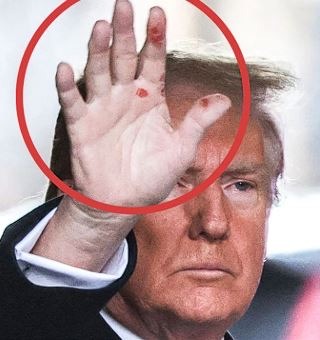
Former President Donald Trump has once again found himself at the center of public attention—but this time, it has nothing to do with campaign rallies, courtrooms, or policy debates. Instead, a series of photos showing noticeable red marks on his hands has ignited a wave of online speculation, debate, and curiosity, proving yet again that even the smallest physical detail can become headline material when it involves one of the most scrutinized figures in modern American politics.
The marks first caught widespread attention after Trump was photographed shaking hands with supporters at recent public appearances. Observers quickly noted reddish patches concentrated on his right hand, particularly around the index finger, thumb, and the upper portion of the palm. The discoloration appeared inconsistent with simple lighting effects and seemed visible across multiple images, prompting users on social media platforms to zoom in, compare photos, and theorize about what might be behind the change.
As is often the case in the digital age, speculation spread faster than facts. Within hours, timelines were flooded with side-by-side images from past events, amateur analyses, and confident claims from people with no direct knowledge of Trump’s health or habits. Some dismissed the marks as meaningless, while others treated them as a clue pointing to something more significant.
The theories ranged widely in tone and seriousness. On the lighter end, some suggested the marks were the result of a mundane mishap—a spill involving ketchup, hot sauce, or even makeup residue transferred during repeated handshakes. Others jokingly blamed household accidents, such as contact with a hot iron or irritation from cleaning products. These explanations leaned into humor, reflecting the internet’s tendency to turn uncertainty into entertainment.
More provocative suggestions also emerged. A few commentators speculated about medical causes, despite having no evidence or professional insight. One political figure known for sharp commentary even joked publicly that the marks resembled symptoms associated with certain illnesses, a remark that quickly circulated and drew both laughter and criticism. While clearly not intended as a serious diagnosis, the comment underscored how quickly health-related speculation can escalate when attached to a high-profile individual.
At the same time, others pointed to Trump’s well-known passion for golf as a possible explanation. An avid golfer for decades, Trump spends significant time on the course, often gripping clubs for hours at a time. Repeated friction, pressure, and exposure to sun and weather conditions can easily lead to redness, irritation, or callusing on the hands—especially in older individuals. Some observers suggested the marks were consistent with mild irritation caused by frequent play, particularly if combined with dry skin or sensitivity.
This explanation struck many as plausible, given Trump’s routine and public lifestyle. Unlike hidden medical conditions, golf-related wear and tear aligns neatly with what is already known about his habits. Still, without confirmation, it remains only one possibility among many.
What has kept the conversation alive is the absence of any official statement. Trump himself has not addressed the marks, nor has his team released any clarification. In the vacuum created by silence, speculation continues to fill the gap. For public figures, especially those who polarize opinion, even a lack of response can become part of the story.
This episode highlights a broader cultural phenomenon: the intense scrutiny applied to the physical appearance of leaders. From hairstyles to posture, from clothing choices to facial expressions, every visible detail is dissected, interpreted, and often exaggerated. In Trump’s case, this scrutiny has been relentless for years, fueled by his unconventional style, frequent public appearances, and deeply divided public perception.
It also raises questions about boundaries. At what point does curiosity become intrusion? Red marks on a hand—something most people would barely notice in their own lives—have become a subject of national conversation simply because of who Trump is. Supporters argue that such speculation is trivial and disrespectful, while critics counter that transparency is fair game for someone seeking or holding power.
Medical professionals, for their part, generally caution against drawing conclusions from photographs alone. Skin discoloration can result from countless benign factors, including minor injuries, allergic reactions, pressure, temperature changes, or simple irritation. Without a clinical examination, any attempt to assign meaning is speculative at best and misleading at worst.
Still, the public fascination persists. In an era where images travel instantly and are endlessly replayed, a single detail can take on outsized importance. Algorithms reward engagement, not accuracy, ensuring that even the smallest mystery can dominate discourse for days.
Whether the red marks are the result of golf, a minor accident, skin sensitivity, or nothing at all, their impact has already been felt. They’ve reminded the public how quickly attention can shift, how easily speculation can overshadow substance, and how modern media thrives on unanswered questions.
Until Trump or his representatives choose to address the issue—or until the marks simply disappear as quietly as they appeared—the conversation is likely to continue in fragmented form, resurfacing with each new photo or public appearance. For now, the red spots remain exactly what they are: unexplained, overanalyzed, and emblematic of the peculiar way public figures are endlessly examined in the digital age.
In the end, the episode says less about the marks themselves and more about the environment in which they were noticed—one where curiosity, humor, suspicion, and speculation coexist, and where even a hand can become a headline.