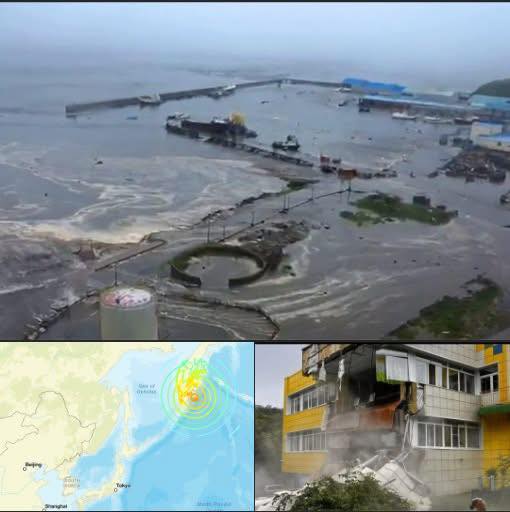
A massive seismic event shook the Pacific on July 30, 2025, when a powerful 8.8-magnitude earthquake struck off the coast of Kamchatka. What began as an early estimate of 8.0 quickly escalated as monitoring agencies upgraded the numbers twice, eventually placing the quake among the strongest recorded globally in modern history. The ground rupture occurred along the Kuril–Kamchatka arc, a notorious segment of the Pacific Ring of Fire where immense tectonic pressure has produced some of the world’s most devastating earthquakes. The epicenter sat roughly 120 to 136 kilometers east-southeast of Petropavlovsk-Kamchatsky, at a shallow depth of about 20 kilometers—shallow enough to cause violent shaking and significant tsunami risk across the region.
The quake stands as the most powerful to hit this part of Russia since the catastrophic 1952 event that generated nine-meter waves and claimed more than two thousand lives. Globally, it now ranks among the top ten strongest earthquakes ever recorded, comparable in magnitude to the 2011 Tōhoku disaster in Japan. Its arrival was sudden, but experts note that the area had been experiencing heightened seismic activity earlier in the month, including a 7.4-magnitude foreshock that, in hindsight, was the precursor to this far larger rupture.
In Kamchatka and the neighboring Kuril Islands, the quake hit with brutal force. Residents reported violent shaking that sent furniture toppling, shattered mirrors, and caused vehicles to sway as if tossed by unseen waves. In Petropavlovsk-Kamchatsky, where the shaking was strongest, power flickered out across several districts, mobile networks collapsed, and a kindergarten’s wall gave way. Miraculously, no casualties were reported from that collapse, though several minor injuries were. Severo-Kurilsk, a community on Paramushir Island with its own tragic history of tsunamis, was struck hard as seawater surged inland. Waves as high as four meters flooded the port and surrounding areas, forcing the evacuation of roughly two thousand residents. Emergency crews rushed in as soon as conditions allowed, redirecting families to high-ground shelters while assessing damage along the battered coast.
Across Sakhalin Island and other vulnerable areas, authorities ordered immediate evacuations. Sirens wailed along the shoreline, and emergency communication channels activated within minutes. For many Russians in these regions, rapid evacuation was a grim but familiar drill—one they performed with urgency, knowing the area’s history all too well.
The Pacific did not wait long to send ripples outward. Tsunami alerts spread across entire coastlines, triggering one of the largest multi-nation evacuation responses since the 2011 Japan disaster. Japan issued sweeping orders affecting zones across multiple prefectures. Depending on the source, between 900,000 and nearly two million residents were advised to relocate to higher ground. Though the waves that reached Hokkaido were relatively small—between 30 and 50 centimeters—the fear stemmed from early forecasts warning of potentially meter-high surges. Precautionary measures extended to critical facilities. At the Fukushima Daiichi nuclear plant, approximately four thousand employees were evacuated as a safety measure. Officials later confirmed no damage.
In Hawaii, the reaction was swift and serious. A statewide tsunami warning went into effect, prompting evacuations along beaches, tourist areas, and low-lying neighborhoods. Flights were halted, ports suspended operations, and emergency transport corridors opened to funnel people inland. Waves of around four feet eventually reached Oʻahu and Maui. Though the islands escaped major damage, the event emphasized how vulnerable the Pacific remains to seismic events thousands of miles away.
Further north, Alaska recorded smaller waves—generally under 30 centimeters—along the Aleutian chain. Still, tsunami warnings and watches stretched across large portions of the state, including areas along the Panhandle and farther south along the U.S. West Coast. In California, tsunami advisories predicted waves up to 1.7 meters in some regions, particularly around Crescent City, a community scarred by past tsunami disasters. Coastal residents were urged to stay away from beaches, harbors, and river mouths until officials lifted the warnings.
The quake triggered alerts across the entire Pacific basin. Chile, Ecuador, Peru, Mexico, Taiwan, Indonesia, the Philippines, New Zealand, and the Solomon Islands issued advisories or warnings, though most ultimately reported minimal wave activity. Chile implemented precautionary measures in several coastal regions and suspended classes while monitoring conditions. In India, officials issued a support advisory for its citizens living in tsunami-risk areas of the U.S. West Coast and Hawaii. They also confirmed that India’s own nuclear installations were unaffected and that no casualties involving Indian nationals had been reported.
Large earthquakes rarely occur without a cascade of aftershocks, and this one was no exception. Several strong jolts followed, including magnitudes of 6.9 and 6.3, centered southeast of Petropavlovsk with depths around 10 kilometers. Seismologists warned that aftershocks as strong as magnitude 7.5 could continue for weeks, possibly longer. The region’s strained fault lines may produce additional activity as the crust settles from the massive release of energy.
Despite the widespread alerts, the scale of damage varied drastically from place to place. Russia bore the brunt of it, with coastal towns flooded and infrastructure rattled. Much of the Pacific, however, experienced only moderate wave activity thanks to early warnings and effective evacuation systems. The quake’s shallow depth and energy output could have resulted in far worse consequences had conditions differed even slightly.
The event served as a stark reminder of just how powerful the Earth’s geologic forces remain—and how, despite modern technology, entire nations can be brought to a standstill in minutes. For the communities of Kamchatka and the Kuril Islands, recovery will unfold slowly as power grids stabilize, roads clear, and families return home to assess what remains. For the broader Pacific, the earthquake renewed conversations about preparedness, early-warning systems, and the constant tension between life along the ocean and the risks that come with it.
This earthquake will be studied for years. Its immense magnitude, the unprecedented scale of international response, and the geological implications all mark it as a defining event of 2025. But for the people who lived through the shaking, the flooding, the evacuations, and the uncertainty, it will be remembered most as the day the Earth moved with a force powerful enough to reach across an entire ocean—and strong enough to reshape countless lives in a matter of minutes.