Denise’s perfume hit me before her voice did—sharp, expensive, and angry. The kind of scent that tried to announce power before the woman even opened her mouth.
I was ninety years old, seated behind my mahogany desk, and I still knew fear when it walked into a room.
Not the fear of getting hit. Not the fear of being robbed. The older kind. The kind that crawled up your spine when you realized someone was about to rip apart the one good decision you’d made.
Denise stood in the doorway of my study like she owned it. Chanel jacket. Perfect hair. Lips pulled into a smile that didn’t touch her eyes.
“Uncle Hutchins,” she said, like she was greeting a waiter. “We need to talk about your will.”
I didn’t flinch. I didn’t invite her to sit. I just watched her glance—too quickly—at the safe built into the wall behind my desk.
She knew.
Someone had told her.

And in that moment, I understood the worst part wasn’t the money.
It was what that money turned people into.
“You haven’t called me in twenty years,” I said calmly.
Denise scoffed. “That’s not the point.”
I leaned back, joints aching the way they always did when the weather shifted. “No,” I said. “That’s exactly the point.”
Her eyes narrowed. “You’re confused. You’re old. You’re letting some employee manipulate you—”
That was when the first real punch landed. Not from her words, but from the memory they triggered.
Because the only reason Denise was standing in my house right now was because I’d spent the last week doing something I never thought I’d do at my age.
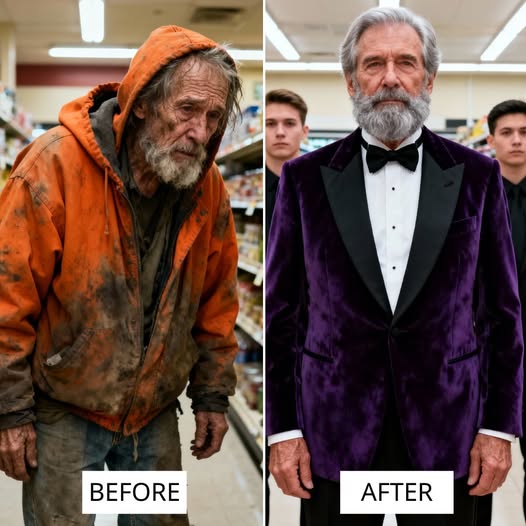
I’d disguised myself as a homeless man and walked into one of my own supermarkets to see who would treat me like a human being when no one important was watching.
And what I found… didn’t just break my heart.
It rewired my entire idea of legacy.
The Day I Became “Your Kind”
I don’t know what you think a billionaire looks like when he’s alone in his own mansion on Christmas week.
Most people imagine cigars and scotch and smug satisfaction.
The truth is uglier.
The truth is quiet.
My wife died in 1992. Clara. Pneumonia that spiraled fast, the kind of sickness that doesn’t care about your bank account. We never had children. We tried, God knows we tried, but life didn’t give us that card.
So I spent decades building a grocery chain instead.
Seventy years. That’s how long I worked.
I started after the war with one dingy corner shop in a dusty Texas town. Back then, bread was a nickel and the butcher knew every customer by name. I slept in the back room some nights because I couldn’t afford the gas to drive home and back.
By the time I turned eighty, my name was on signs in five states. People called me “the Bread King of the South” like I’d invented flour. They shook my hand too hard, laughed at jokes that weren’t funny, and told me I was an inspiration.
But money doesn’t laugh with you over breakfast.
And power doesn’t hold your hand when the house gets too quiet.
One night last year, I sat alone in my study staring at a portrait of my wife and realized something that chilled me more than any winter storm ever had:
When I die… who gets it all?
A board of directors that would sell the company in six months?
A pack of relatives who couldn’t be bothered to ask if I’d eaten?
Denise—my late brother’s daughter—who’d treated me like a vault her whole adult life?
I didn’t want my life’s work to become a prize for people who only loved me on paper.
So I decided to test the one thing I could still control.
Truth.
I put on my oldest clothes—work pants with stains that didn’t come out, boots with split seams, a flannel shirt frayed at the cuffs. I didn’t shave. I rubbed a little dirt into my cheeks, messed my hair, and practiced looking down the way people do when they’re used to being ignored.
Then I walked into Store #14 on the outskirts of Dallas—one of my best-performing locations—on a Tuesday afternoon.
I didn’t bring a driver.
I didn’t bring security.
I didn’t bring my name.
I brought my body and my dignity and a test that felt like walking into fire.
The automatic doors whooshed open.
And the air changed.
Not physically—same store smells: oranges, cleaner, bakery sugar—but socially. Like every eye in the building sharpened the second they saw me.
I could feel the stares before I saw them.
A cashier no older than twenty wrinkled her nose and muttered to her coworker, loud enough for me to hear, “Jeez, he smells like garbage meat.”
They giggled.
A man in line tugged his son closer.
“Don’t stare at the bum, Tommy.”
“But Dad, he looks—”
“I said don’t.”
I walked slowly down the first aisle, pushing an empty cart like I had business there. My heart was beating too hard. Not because I was afraid someone would attack me. Because I was watching people treat me like I was contagious.
This store had my name on the sign outside.
And inside, I was “your kind.”
I rounded the corner toward the produce section when a voice snapped behind me.
“Sir. You need to leave.”
I turned.
Kyle Ransom—floor manager. A man I’d promoted myself five years ago after he saved a shipment from getting destroyed in a warehouse fire. I remembered shaking his hand and saying, Good work. We need men who stay calm.
Now he looked at me like I was a stain.
“Customers are complaining,” he said sharply. “We don’t want your kind here.”
Your kind.
My jaw tightened so hard I felt it in my ears.
I’d built this floor. Paid his salary. Signed his bonuses. My name sat on his pay stubs.
But he didn’t recognize me.
And the uglier truth was that even if he had, the cruelty in his voice was real. It didn’t come from confusion. It came from belief.
“I’m just—” I began, keeping my voice gravelly, small.
Kyle stepped closer, chest puffed. “No. Out. Now. Before I call security.”
I could’ve ended the test right then. I could’ve pulled out my wallet, shown him my ID, watched his face turn inside out with panic.
But I didn’t.
Because I didn’t come there to be obeyed.
I came there to see who would do right when they thought it didn’t matter.
I turned my cart around slowly.
And that’s when a hand touched my arm.
I flinched on instinct.
Not because it hurt. Because nobody touches the homeless unless they want something—pain, entertainment, or proof they can.
“Hey,” a voice said quietly. “Wait.”
I looked up.
A young man—late twenties. Sleeves rolled up. Faded tie. Tired eyes that looked like they’d seen too much life for his age. His name tag read:
LEWIS — Junior Administrator
He didn’t look at Kyle.
He looked at me.
“Come with me,” he said.
Kyle snapped, “Lewis, don’t—”
Lewis cut him off calmly. “I’ve got it.”
He guided me past the stares, past the whispers, past Kyle’s stiff anger, and into a door marked EMPLOYEES ONLY like I belonged there.
Into the staff lounge, he poured me a cup of coffee with shaking hands and handed me a wrapped sandwich from his own lunch bag.
“You don’t have to—” I croaked.
“You do,” he said, sitting across from me. “You’re hungry.”
“I got no money, son,” I said, staying in character.
Lewis’s smile was the first genuine thing I’d seen in that store.
“That’s okay,” he said. “You don’t need money to be treated like a human being.”
My throat tightened.
He didn’t know who I was.
He thought he was feeding a homeless old man who smelled like trouble and embarrassment.
And he did it anyway.
He didn’t ask for a photo.
Didn’t post about it.
Didn’t look around to see who was watching.
He just… stayed.
“You remind me of my dad,” he said after a moment.”. Tough guy. Lost him last year.” He swallowed hard, eyes shining. “He used to say the world will try to make you feel invisible. Don’t let it.”
He leaned forward slightly. “I don’t know your story, sir. But you matter. Don’t let people like Kyle make you feel like you don’t.”
I stared at him, feeling something inside me crack. Not sadness. Recognition.
This was the kind of man I wished I’d had as a son.
Not because he was perfect.
Because he was human.
I finished the coffee. I took two bites of the sandwich and forced my hands not to shake.
Then I stood.
Lewis followed me back into the store like a shield.
Kyle’s eyes narrowed, but he didn’t say a word.
I walked out through the automatic doors with tears burning behind the dirt on my face.
No one knew who I was.
But I knew who Lewis was.
And that was the point.
The Will I Rewrote
That night, I sat alone in my study under the heavy eyes of portraits and memories and wrote a new will.
Not because I was angry.
Because I was certain.
Every penny, every asset, every square foot of the empire I’d bled to build—my chain, my real estate holdings, my investments—would go to Lewis.
A stranger, legally.
But not anymore.
The next week, I returned to that same store.
No disguise this time.
Charcoal-gray suit. Cane polished. Italian shoes shining like mirrors.
My driver opened my door. The automatic doors slid open like they recognized royalty.
And suddenly the entire building was a different place.
Smiles snapped onto faces. Postures straightened. “Mr. Hutchins!” echoed through the aisles like a prayer.
Kyle Ransom rushed up so fast he nearly tripped.
“M-Mr. Hutchins,” he stammered. “I didn’t know you were visiting today.”
I looked at him for a long moment.
His eyes were full of fear now.
Not remorse. Fear.
Fear that his behavior had consequences when aimed at the wrong person.
I turned my gaze past him.
Lewis stood behind customer service, holding a clipboard. Our eyes met.
He didn’t smile.
He didn’t perform.
He just nodded once—small, steady—like he’d already known this day would come.
That night, my phone rang.
“Mr. Hutchins?” Lewis’s voice came through, tight with emotion. “I… I think it was you. The homeless man. I recognized your voice.”
I closed my eyes.
“I didn’t say anything,” he added quickly. “Because… kindness shouldn’t depend on who someone is. You were hungry. That’s all I needed to know.”
He passed the final test without even knowing there was a test.
The next morning, I walked into Store #14 with lawyers.
Kyle was terminated on the spot. The cashier who’d laughed about “garbage meat” was fired too, along with two others who had piled on.
Not because I was petty.
Because culture is built from what you tolerate.
And I’d tolerated rot too long.
I gathered the remaining staff in the break room.
I pointed at Lewis.
“This man,” I said, voice steady, “is your new manager.”
Mouths dropped.
And then I added what turned the room into silence:
“And he will be the next owner of this entire chain.”
Lewis went white. His hands shook.
He didn’t look triumphant.
He looked… terrified.
Because good people don’t crave power.
They worry about whether they deserve it.
That’s why they do.
The Letter That Hit Like a Knife
I was days away from signing the final documents—trust transfers, ownership restructuring, board approvals—when the letter arrived.
Plain white envelope. No return address.
My name, written in shaky, slanted handwriting.
One line.
“Do NOT trust Lewis. He’s not who you think he is. Check the prison records. Huntsville. 2012.”
My hands—steady even at ninety—trembled.
I hated that it worked. Hated that doubt slipped under my skin so easily.
But I’d built my entire life on one principle:
Trust is not blind.
Trust is verified.
I called my lawyer.
“Dig into it,” I said. “Quietly. Don’t let Lewis catch wind.”
By evening, I had the answer.
At nineteen, Lewis was arrested for grand theft auto.
Eighteen months in prison.
The air in my lungs turned sharp.
I sat in my study staring at the report, feeling anger and confusion twist together like barbed wire.
Had I been played?
Had I done exactly what Denise always accused me of—gotten sentimental and stupid?
I called Lewis in.
He arrived within twenty minutes, posture straight, face pale, eyes steady like a man walking into a firing squad.
I held up the report.
“Why didn’t you tell me?” I asked, not shouting. Each word was a stone.
Lewis didn’t flinch.
“I was nineteen,” he said quietly. “Stupid. Thought I was invincible. I took a joyride in a car that wasn’t mine. Got caught. Paid for it.”
“You lied,” I said.
He shook his head. “I didn’t lie. I just… didn’t tell you.”
My jaw tightened. “That’s a lie when you know the truth would change what someone decides.”
Lewis swallowed. His hands were clenched so hard his knuckles were white.
“I didn’t tell you because I knew you’d shut the door,” he said. “Most people do. I’ve spent my entire adult life trying to earn my way back into being seen as a person. Prison didn’t just punish me—it stripped me.”
He looked me in the eye, voice steady.
“I learned what it feels like to lose dignity. To be reduced to a number. To be called ‘your kind.’”
My stomach turned because I heard my own words echoing back from the grocery store.
“I’ve been working to make it right ever since,” he continued. “That’s why I treat people the way I do. Because I know what it feels like when no one does.”
Silence sat between us like a third man.
I studied him.
The guilt in his eyes wasn’t performative.
It was earned.
And something inside me shifted.
Because a spotless record doesn’t always mean a good heart.
And a stained past doesn’t always mean a rotten one.
“You should have told me,” I said finally.
“I know,” he whispered. “I’m sorry.”
I leaned back in my chair.
The truth was, his past didn’t disqualify him.
It explained him.
And maybe it made him even more suited to inherit something that was supposed to feed people, not just profit from them.
But the storm hadn’t even arrived yet.
Because a few days later, word leaked that I was rewriting my will.
And suddenly my phone rang like it was 1974.
Cousins who hadn’t spoken to me since disco was popular were “checking in.” Old colleagues invited me to lunch, calling me “sir” with extra sugar.
And then Denise arrived.
The Woman Who Came for a Signature
Back in my study, Denise stood by my safe with that same entitlement she’d worn since she was twenty.
“You can’t be serious,” she snapped. “A grocery employee? Over family?”
“You’re not family,” I said calmly. “You’re a relative.”
She scoffed. “That’s the same thing.”
“No,” I corrected. “Family shows up. Family calls. Family sits by the bed when you’re sick instead of waiting for the obituary.”
Her eyes narrowed. “You’re confused. He’s using you.”
I stood slowly, bones aching, but my voice steady.
“Blood doesn’t make family,” I said. “Compassion does.”
Denise’s face twisted.
“Fine,” she hissed. “Do what you want. But if you give him everything, we’ll ruin him. We’ll drag up his record. We’ll make sure he never enjoys a dime.”
And then she did something that snapped my patience clean in half.
She spat at my feet.
Then stormed out.
That night, I heard a sound in my study.
A soft scrape.
A drawer.
I opened the door and found Denise with a flashlight, hands inside my desk, yanking files like a thief too angry to hide it.
She looked up without shame.
“I know you changed your will,” she hissed. “I’m not letting you do this.”
That was when fear finally arrived.
Not for my money.
For Lewis.
Because my family didn’t just want inheritance.
They wanted control.
And Lewis—kind, flawed, good-hearted Lewis—had become their target.
So I made the decision that ended this story the way it needed to end.
Not with revenge.
With protection.
The Final Move
The next morning, I called Lewis into my real office—my corporate office.
Not the grocery store back room.
Not the break room.
The executive suite with the framed blueprints, the oil paintings of the first store, the heavy desk that carried seventy years of contracts.
He walked in cautiously, eyes scanning the room like he still couldn’t believe he belonged anywhere near it.
“Close the door,” I said.
He did.
Then I slid a folder across the desk.
It wasn’t a will.
It was a trust structure—already prepared, already signed by my attorney, already set up to protect the inheritance from exactly the kind of attack Denise was planning.
His eyes widened as he read.
“You… did this already?” he whispered.
“I didn’t build this company by waiting for people to show their teeth before I prepared,” I said.
Lewis swallowed hard. “Mr. Hutchins—”
“Call me Henry,” I interrupted.
He blinked.
I leaned forward.
“You’re going to be attacked,” I said plainly. “Not physically. Not at first. They’ll go for your name. Your record. They’ll try to shame you into stepping away.”
Lewis’s jaw tightened. “Let them.”
I studied him.
“You’ll need help,” I said.
He nodded once. “I know.”
I opened the drawer and pulled out another envelope.
Inside was a letter—one I’d written for the board, for the media, for anyone who tried to twist the narrative.
It wasn’t emotional.
It was surgical.
A statement of choice.
A declaration that the company would not be inherited by blood, but by character proven under pressure.
I slid it across to him.
“You won’t fight them with rage,” I told him. “You’ll fight them with stability. With integrity. With receipts.”
Lewis stared at the paper, then looked up at me.
“Why are you doing this?” he asked quietly. “Why me?”
Because the answer mattered.
I didn’t say, because you made me feel less alone.
I didn’t say, because my own family treats me like a wallet.
I said the truth that had been burning in my chest since the staff lounge.
“Because when you thought I was nothing,” I said, “you treated me like I mattered.”
Lewis’s eyes shone.
And for the first time in a long time, I felt warm—not because of money or legacy or power.
But because I’d finally chosen to leave something behind that meant something.
The papers were signed two days later.
Denise tried to contest it. She failed.
Kyle tried to sue. He failed.
Rumors about Lewis’s prison record floated around like vultures.
And Lewis didn’t hide.
He stood up in front of every manager in the company and said plainly:
“I went to prison at nineteen. I did my time. I changed. If you want to judge me, judge me by who I am now.”
Half the room respected him more for it.
The other half left.
Good.
A company doesn’t deserve to survive if it can’t handle truth.
On the last day I walked into Store #14, Lewis met me at the entrance.
No longer in a faded tie.
Now in a suit that fit him like a man who’d grown into himself.
“How are you feeling?” he asked.
“Ninety,” I replied.
He laughed.
I looked around at the aisles, the customers, the employees who now nodded at janitors and helped elderly shoppers without being asked.
It wasn’t perfect.
But it was better.
And at my age, better is a miracle.
When I left, I didn’t look back at the sign with my name on it.
I looked at the people inside.
Because I finally understood the thing that took me seventy years to learn:
A legacy isn’t your name on a building.
It’s the way the building treats the invisible.
And if you’re reading this thinking I’m some sentimental old fool, you might be right.
But I’d rather die a fool who chose kindness than a legend who left behind rot.